
Friction and Lichen Sclerosus: The Trigger Nobody Talks About
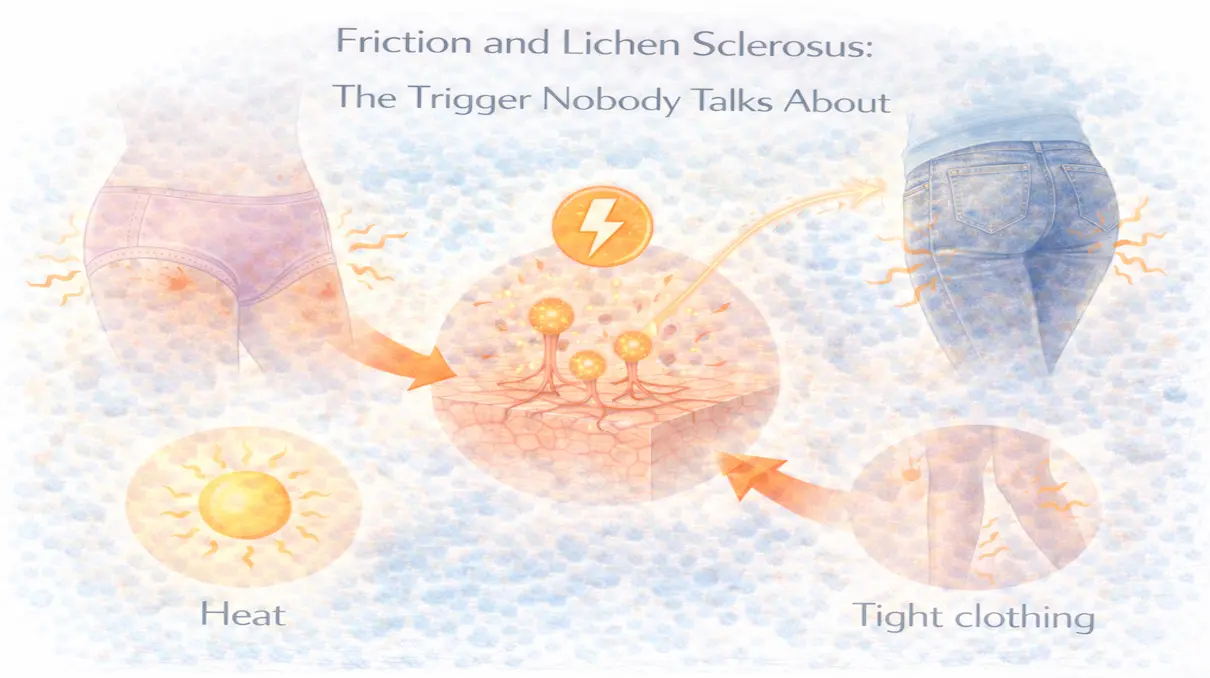
When people talk about lichen sclerosus triggers, they usually focus on hormones, immunity, or infections.
Very few are warned about friction.
In real life, friction is one of the strongest and most underestimated drivers of LS symptoms, including burning, tearing, post treatment flares, and the feeling that the disease “keeps coming back” despite correct medical care.
This is not alternative thinking.
It is basic skin biology.
Once you understand how friction interacts with LS skin, many confusing patterns suddenly make sense.
Why Lichen Sclerosus Skin Reacts Differently to Friction
LS skin is not normal skin, even when it looks calm.
Biologically, it tends to be:
- thinner and less elastic
- slower to recover from micro-injury
- more sensitive at the nerve level
- more vulnerable to barrier disruption
That means forces tolerated easily by healthy skin like walking, sitting, wiping, clothing movement, sexual motion can repeatedly stress LS skin.
Each stress alone is small.
The cumulative effect is not.
Friction Can Reactivate Inflammation Without Visible Damage
One of the most confusing aspects of LS is this:
The skin can look normal
yet burn, sting, or feel raw.
This happens because friction:
- disrupts an already fragile barrier
- exposes sensitized nerve endings
- activates local immune signaling at a microscopic level
Mechanical stress alone can reactivate inflammatory pathways involved in LS, including TNF-α, IL-1β, and interferon driven signaling, even without visible redness or tearing.
This is why people experience:
- burning without lesions
- soreness without cracks
- “flares” without obvious skin change
The inflammation is real it’s just not always visible.
Why Steroids Help but Don’t Solve Friction
Topical steroids suppress inflammation.
They do not remove mechanical stress.
This explains a very common pattern:
- clobetasol calms a flare
- symptoms improve
- treatment stops
- burning or irritation returns
It’s often assumed the steroid “stopped working.”
In reality, friction restarted the inflammatory loop.
This is also why, once friction is controlled, many people no longer need the strongest steroid:
- clobetasol is useful during high inflammatory load
- mometasone is often sufficient when inflammation is moderate
- hydrocortisone can be enough for low grade inflammation or tapering
When friction is reduced, escalation is often unnecessary.
Everyday Sources of Friction People Miss
Friction is not just sex.
Daily sources include:
- walking and prolonged sitting
- underwear seams and elastic
- tight or rough fabrics
- repeated wiping after urination
- drying with towels
- exercise combined with heat and moisture
These forces act every day, for hours.
This is why LS often worsens:
- after long days out
- during travel
- in warm weather
- when activity increases
Not because the disease changed
but because mechanical load increased.
Why LS Can Feel Worse
After
Improvement
Another confusing pattern:
- inflammation improves
- skin looks better
- sensitivity increases
This is often blamed on “steroid damage.”
What’s really happening:
- inflammation is suppressed
- nerves are still sensitized
- the barrier is still fragile
Without protection, friction becomes more noticeable, not because the skin is worse, but because it’s exposed.
This is where barrier strategy matters.
Barrier Protection Is Friction Management, Not Moisturizing
In LS, barrier products are often misunderstood.
Their main role is not hydration.
It is friction reduction.
Properly used barriers:
- reduce shear forces
- limit skin-to-fabric and skin to skin contact
- protect healing tissue from re-injury
This is why simple products often work best:
- petrolatum (Vaseline) for strong friction protection
- Cicalfate when the skin feels raw or irritated
- Cicaplast B5+ for lighter daily barrier support
- zinc based barriers, VEA Lipogel, Vitamono EF in maintenance phases
They don’t treat LS.
They prevent the mechanical triggers that keep it active.
Friction and Tearing Are Closely Linked
Tearing in LS rarely happens “out of nowhere.”
It usually occurs when:
- tissue is inflamed or recently inflamed
- elasticity is reduced
- friction exceeds tolerance
Reducing friction lowers tearing risk more reliably than increasing steroid potency.
Friction Explains Long-Term Stability (or Lack of It)
People who successfully control LS long term usually do three things together:
- suppress inflammation when active
- taper steroids appropriately
- (clobetasol → mometasone → hydrocortisone when possible)
- minimize daily mechanical stress
Those who control friction often notice:
- fewer flares
- less burning between flares
- less need for strong steroids
- more predictable skin behavior
This is not coincidence.
It’s mechanics.
Final Thought
Friction is not a minor trigger in lichen sclerosus.
It is a constant, cumulative force acting on skin that is already vulnerable.
Medication controls inflammation.
Friction determines whether that control lasts.
When friction is reduced, inflammation becomes easier to manage often with lower potency steroids, less fear, and far better long term outcomes.

.webp)
.webp)


