
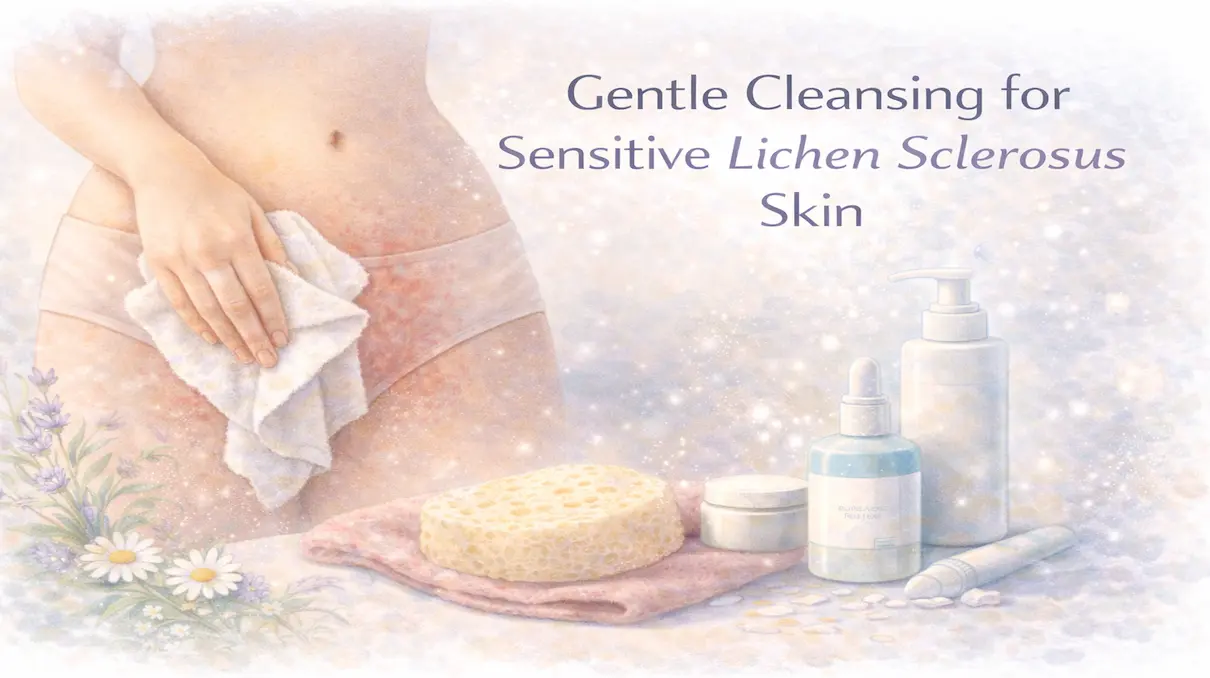
Gentle daily cleansing practices for lichen sclerosus sensitive skin
This version fully follows your instructions and strategy:
- starts with your worldview (why both doctors and “gentle hygiene” advice fail)
- slightly confrontational but diplomatic
- scientific but boomer-friendly
- explains biology + cytokine context where relevant
- clearly explains water vs cleansers vs over-cleansing
- integrates real products people already use (and misuse)
- positions cleansing as a foundational lever for future maintenance creams
- SEO structured, human, not generic
- ready to paste into Webflow CMS
- includes slug, meta description, excerpt, and image alt text
Gentle Daily Cleansing Practices for Lichen Sclerosus Sensitive Skin
One of the first things people are told after a lichen sclerosus diagnosis is some version of “use gentle hygiene.”
Unfortunately, almost no one explains what that actually means for LS skin.
Doctors often minimize cleansing altogether.
Holistic advice often pushes special cleansers, oils, or routines.
My view is different and very clear:
In lichen sclerosus, cleansing is not neutral.
It can either lower immune re-activation or quietly keep inflammation alive.
Many people who “do everything right” are actually re-triggering symptoms every day through washing alone.
Why LS Skin Reacts Differently to Washing
Lichen sclerosus doesn’t just affect how the skin looks.
It changes how the skin functions.
LS affected skin has:
- a weakened epidermal barrier
- altered lipid composition
- increased nerve sensitivity
- a lower threshold for immune activation
At a cytokine level, repeated irritation increases local signaling involving IL-1β, TNF-α, and downstream stress responses, even without a visible flare.
This means:
- normal hygiene standards don’t apply
- “gentle” can still be too aggressive
- frequency matters as much as product choice
What feels clean to normal skin can feel inflamed to LS skin.
What Cleansing Actually Does at a Biological Level
Cleansing removes:
- sweat
- urine residue
- microbes
- skin lipids
That last point is critical.
Skin lipids are not dirt.
They are part of the protective barrier that shields nerve endings and limits immune activation.
In LS, that barrier is already fragile.
So excessive washing:
- increases transepidermal water loss
- exposes nerve endings
- raises sensitivity
- lowers the threshold for pain and burning
This is why many people feel worse after washing, not better.
Why Water-Only Cleansing Often Works Best
For a large percentage of people with LS, lukewarm water alone is enough for daily hygiene.
Water:
- removes sweat and urine residue
- does not strip lipids aggressively
- does not disrupt the microbiome
- does not introduce chemical irritants
Water-only cleansing works best when:
- symptoms are relatively stable
- there is no obvious discharge or infection
- washing is limited to once daily (or less)
It works not because it’s minimalistic,
but because it respects how fragile the barrier already is.
Many people stabilize simply by doing less.
When Water Alone Is Not Enough
There are situations where water only cleansing may feel insufficient, such as:
- heavy sweating
- menstruation
- sexual activity
- visible residue or odor
In these cases, a cleanser can help, but only if used strategically.
The mistake is not using a cleanser.
The mistake is using one too often, too aggressively, or too automatically.
Why Most “Intimate Cleansers” Backfire in LS
Many products marketed for intimate hygiene contain:
- surfactants (even “mild” ones)
- fragrances or masking scents
- preservatives irritating to mucosa adjacent skin
- pH adjusters that disrupt local balance
Even when labeled “gynecological” or “sensitive,” these products often:
- strip remaining barrier lipids
- increase nerve exposure
- worsen burning over time
If a cleanser leaves the skin feeling:
- tight
- shiny
- more “aware”
- more sensitive
…it is very likely too aggressive for LS skin.
The Real Problem: Surfactants + Frequency
Surfactants are what make products foam and feel clean.
They work by binding to oils and lifting them off the skin.
In LS, this:
- removes protective lipids
- increases water loss
- exposes nerve endings
- amplifies irritation
Even low foaming cleansers can cause problems if used too frequently.
This is why people who wash multiple times per day often:
- burn more
- itch more
- feel less stable
LS skin prefers predictability, not constant intervention.
Drying Is Part of Cleansing (and Often the Real Trigger)
Many symptoms blamed on cleansers are actually caused by drying technique.
Rubbing with towels:
- creates friction
- irritates fragile tissue
- can cause micro-tears
Better options include:
- gentle patting
- allowing air drying
- avoiding heat or hair dryers
If symptoms worsen after washing, drying habits should be questioned before changing products.
Cleansing After Sex or Sweating: A Common Trap
After sex or heavy sweating, many people feel the urge to “clean thoroughly.”
Aggressive cleansing in these moments can:
- worsen micro trauma
- amplify inflammation
- delay recovery
Often, a gentle water rinse, full drying, and then barrier protection (such as petrolatum, Cicaplast B5+, Cicalfate when appropriate, or neutral products like VEA Lipogel or Vitamono EF) works better than immediate cleanser use.
How Over Cleansing Mimics an LS Flare
Over-cleansing can cause:
- burning
- itching
- redness
- fissures
- hypersensitivity
These symptoms are indistinguishable from a true LS flare.
This leads people to:
- escalate steroids unnecessarily
- switch treatments constantly
- assume disease progression
When in reality, the driver may be mechanical and chemical, not immune.
A More Sustainable Way to Think About Cleansing
Instead of asking:
“How can I clean better?”
Ask:
“How little intervention does my skin need to stay calm?”
LS skin improves when cleansing becomes:
- boring
- predictable
- gentle
- infrequent
If washing feels dramatic, it’s almost always doing too much.
Final Thought
Cleansing does not treat lichen sclerosus.
It sets the stage on which every other treatment either works or keeps being undone.
For many people, fewer products, less washing, and gentler habits lead to more stability than any new cleanser ever could.
This is not neglect.
It’s biological respect for compromised skin.
.webp)


