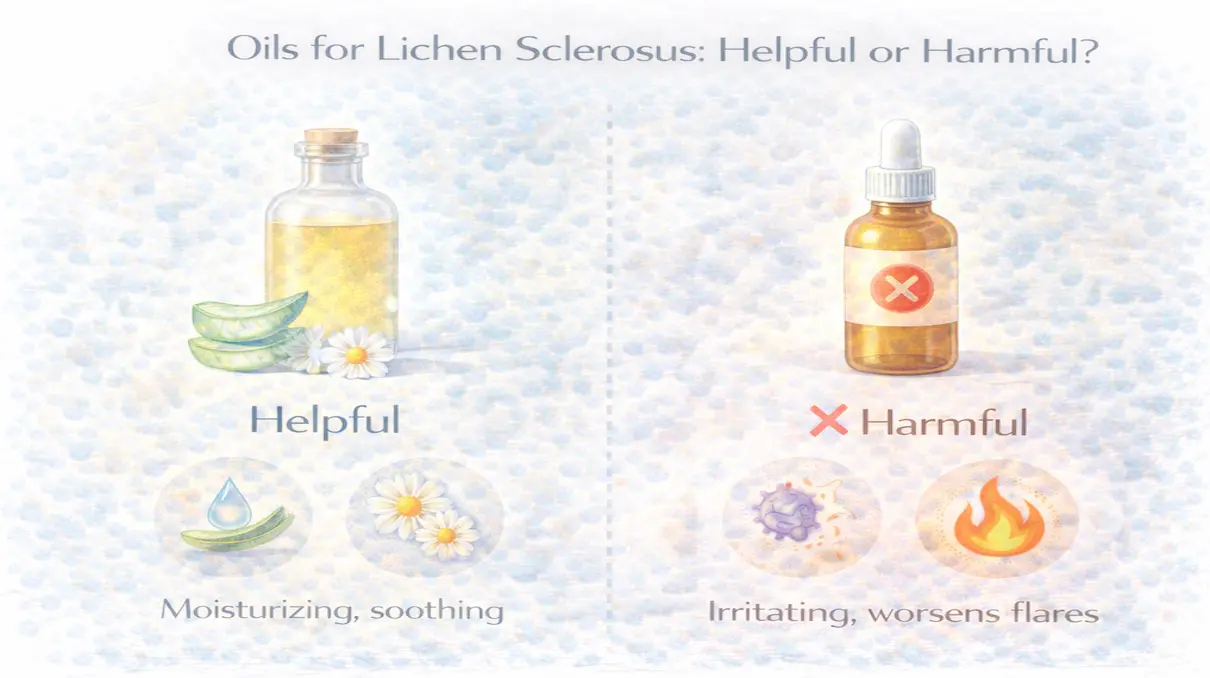
Oils for Lichen Sclerosus: Helpful or Harmful?
If there’s one topic in lichen sclerosus that creates the most division, it’s oils.
Coconut oil.
Olive oil.
Castor oil.
Essential oils diluted in carriers.
Some people swear they saved them.
Others flare badly and never recover.
This usually leads to rigid opinions:
“Oils healed me” vs “oils ruined me.”
The truth is less emotional, and more biological.
Oils can help in very specific situations.
They can also quietly make LS worse.
Understanding why requires understanding what LS actually is, and what oils actually do.
Why Oils Feel Helpful at First
Oils almost always feel good initially.
They:
- reduce surface friction
- soften stiff skin temporarily
- coat exposed nerve endings
- reduce the sensation of dryness
For people whose symptoms are driven mainly by mechanical irritation, this can feel like real improvement.
But comfort is not the same as disease control.
What Oils Do
Not
Treat in Lichen Sclerosus
Lichen sclerosus is not caused by a lack of oil.
It is driven by:
- immune dysregulation
- cytokine signaling (IFN-γ, TNF-α, IL-1 pathways)
- inflammatory damage to skin structure
Oils do not:
- suppress immune activity
- reduce inflammatory cytokines
- stop collagen remodeling
- prevent progression
When inflammation is active, oils work only on the surface while the disease process continues underneath.
That’s why relief is often temporary.
Why Oils Often Make LS Worse Over Time
In many people, oils backfire after days or weeks.
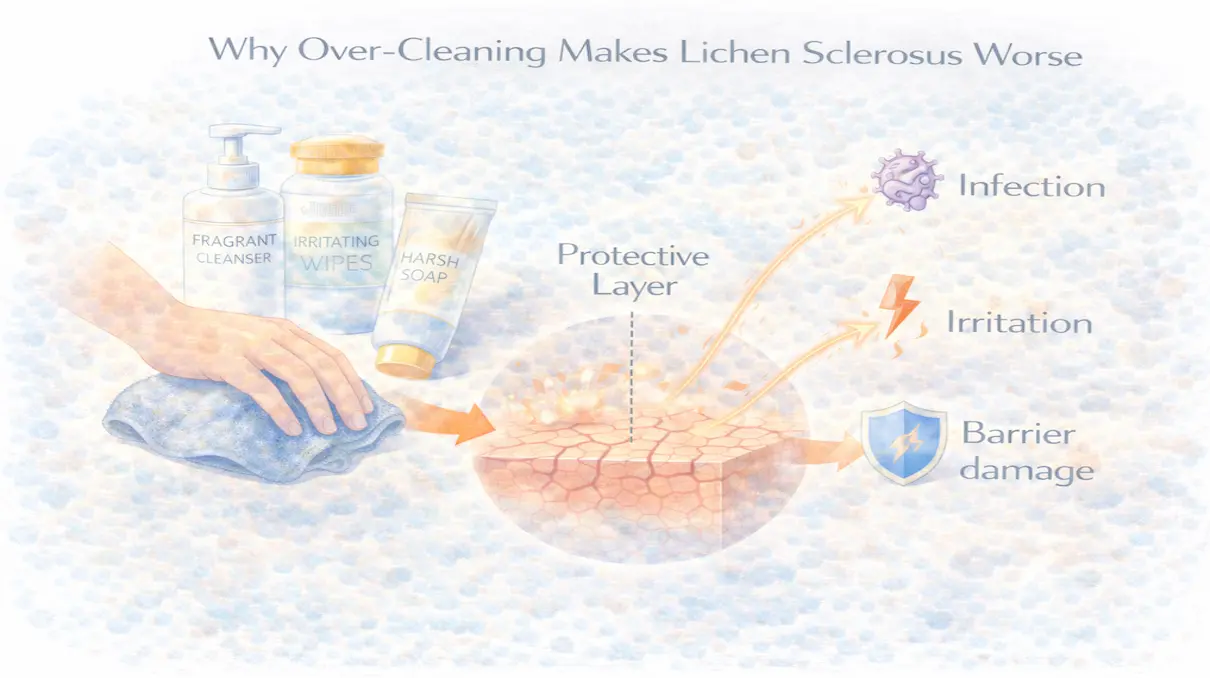
This happens because oils:
- trap moisture against fragile skin
- alter the local microbiome
- increase maceration
- change friction dynamics during movement
LS skin already has:
- a weakened barrier
- lower tolerance to moisture and heat
- heightened nerve sensitivity
Prolonged occlusion can:
- increase burning
- worsen soreness
- trigger flares without visible redness
When this happens, people are often told it’s “detox” or “purging.”
Biologically, it’s irritation.
Oils vs Barrier Creams: Not the Same Thing
This distinction is critical.
Barrier creams (like petrolatum-based products):
- sit on the surface
- reduce shear forces
- are inert and stable
- don’t oxidize or penetrate unpredictably
Oils:
- absorb variably
- oxidize over time
- interact with skin lipids
- behave differently depending on heat and moisture
This is why many people tolerate Vaseline, Cicalfate, or Cicaplast B5+, but react poorly to oils, even “natural” ones.
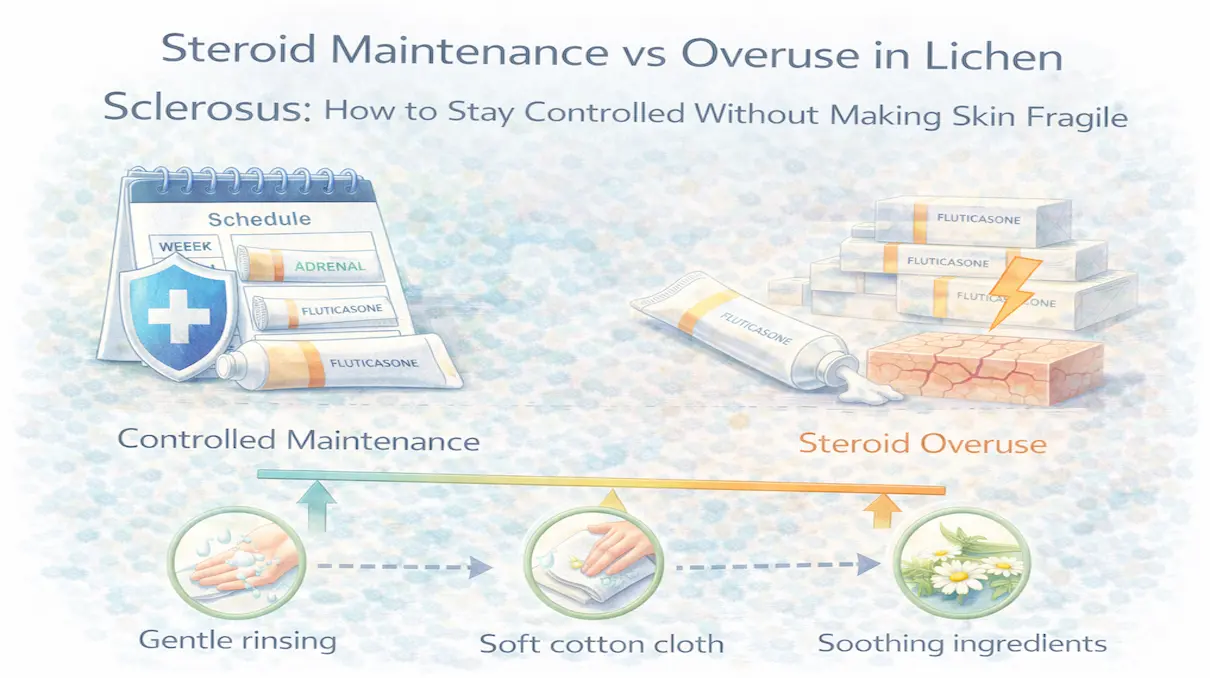
Why Oils Are Often Used Instead of Steroids
Fear plays a big role.
Steroids feel:
- medical
- powerful
- risky
Oils feel:
- natural
- safe
- self controlled
So people often:
- reduce steroid use too early
- increase oil application
- feel temporarily better
- then flare again
This creates the illusion that:
- steroids “stopped working”
- oils are controlling the disease
In reality, inflammation was never fully suppressed.
The Role of Anti-Inflammatory Treatment (Clear and Simple)
When inflammation is active, it must be treated at the immune level.
That does not always mean clobetasol.
In real-world LS management:
- clobetasol is appropriate for strong, active inflammation
- mometasone is often enough when inflammation is moderate
- hydrocortisone can be sufficient for mild activity or tapering
Once inflammation is controlled, surface comfort strategies make sense.
Using oils before inflammation is controlled is backwards.
When Oils
May
Be Reasonable
Oils may be tolerated when:
- inflammation is fully controlled
- the skin is stable
- symptoms are mainly mechanical
Even then, they should be:
- simple (single-ingredient)
- fragrance-free
- used sparingly
- stopped immediately if burning or stickiness appears
If symptoms worsen over days, oils are not helping, even if they felt good initially.
Why LS Is Not a “Dry Skin” Condition
LS skin can look dry, but dryness is not the core problem.
The real drivers are:
- inflammation
- barrier fragility
- mechanical stress
Treating LS as a dryness disorder leads to:
- temporary comfort
- delayed treatment
- worse long-term control
This is why people who rely on oils alone often stay stuck.
Where Barrier Products Actually Fit
Barrier products make sense after inflammation is controlled.
This is where products like:
- petrolatum (Vaseline)
- Cicalfate
- Cicaplast B5+
- zinc-based barriers
- VEA Lipogel
- Vitamono EF
can help maintain stability by reducing daily re-injury.
They prevent triggers.
They don’t suppress disease.
Final Thought
Oils are not evil.
They are also not treatment.
They can reduce friction temporarily, but they do not control inflammation, and in many cases, they worsen it quietly.
Long-term stability in lichen sclerosus comes from:
- matching steroid potency to inflammation severity
- (clobetasol → mometasone → hydrocortisone when possible)
- stabilizing the skin barrier
- minimizing mechanical stress
Oils may play a minor, occasional role,
but they should never replace proper treatment.