Why Over Cleaning Makes Lichen Sclerosus Worse
One of the most common instincts in lichen sclerosus is this:
when symptoms increase, people clean more.
They wash more often.
They use gentler products then different ones.
They try to feel “fresh,” “safe,” or “protected.”
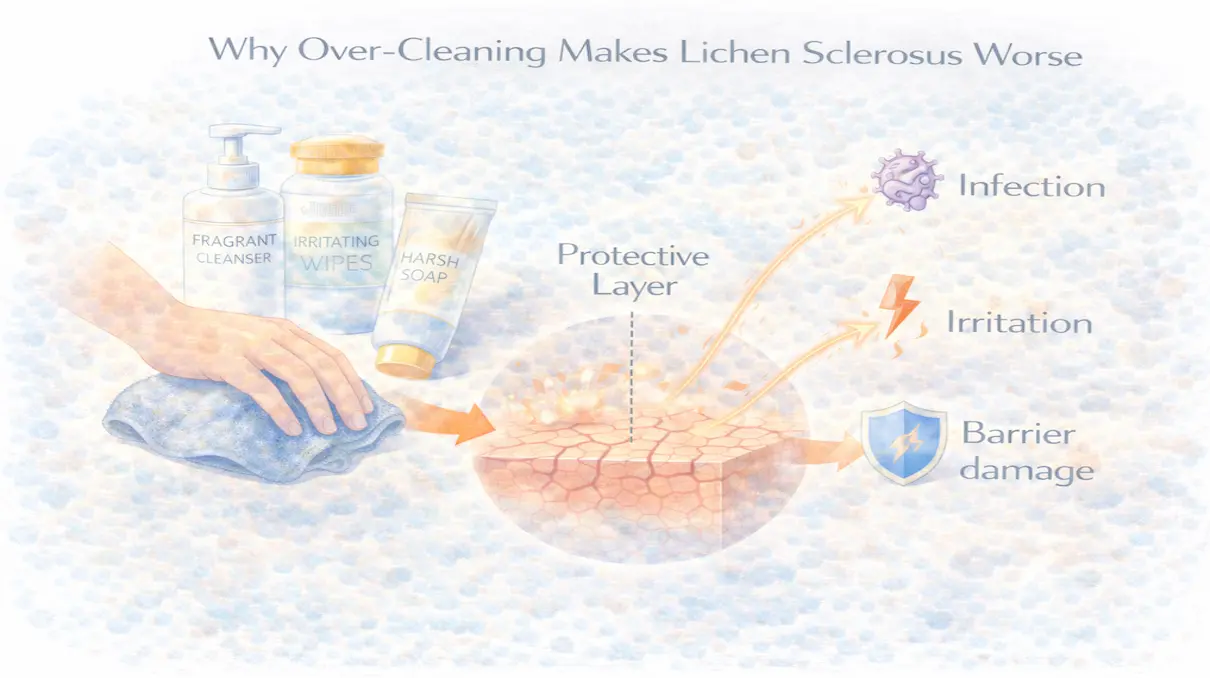
In real life, over cleaning is one of the fastest ways to destabilize LS skin, even when medical treatment is otherwise correct.
This is not about hygiene mistakes.
It’s about misunderstanding how LS skin actually works.
Lichen Sclerosus Skin Is Not Built for Frequent Cleansing
LS skin is biologically different, even when it looks normal.
It typically has:
- reduced lipid protection
- increased permeability
- exposed or sensitized nerve endings
- lower tolerance to chemical and mechanical stress
Cleansing directly interferes with this fragile balance.
What feels “normal hygiene” for healthy skin can be inflammatory input for LS skin.
Over Cleaning Creates a Self Reinforcing Irritation Loop
Frequent washing does more than remove sweat or residue.
It:
- strips protective lipids
- increases transepidermal water loss
- exposes nerve endings
- lowers tolerance to friction
The result is often:
- burning without redness
- tightness after washing
- soreness that feels unexplained
People then respond by cleaning again, which reinforces the cycle.
At that point, symptoms are no longer driven mainly by disease activity, but by barrier damage and nerve irritation.
Why Symptoms Worsen Even When the Skin Looks “Clean”
LS symptoms are not caused by surface dirt.
They are driven by:
- immune signaling
- barrier dysfunction
- nerve sensitization
Over-cleaning worsens all three.
This is why many people flare despite impeccable hygiene, and sometimes because of it.
Clean does not mean calm.
Cleansers Are Not Neutral in Lichen Sclerosus
Even “gentle,” “intimate,” or “gynecological” cleansers contain surfactants.
Surfactants:
- dissolve lipids
- alter the local microbiome
- increase skin permeability
On LS skin, this can reactivate inflammation without visible irritation.
For many people, lukewarm water alone is sufficient for daily cleansing.
Cleansers should be:
- occasional
- situational
- minimal
Not automatic.
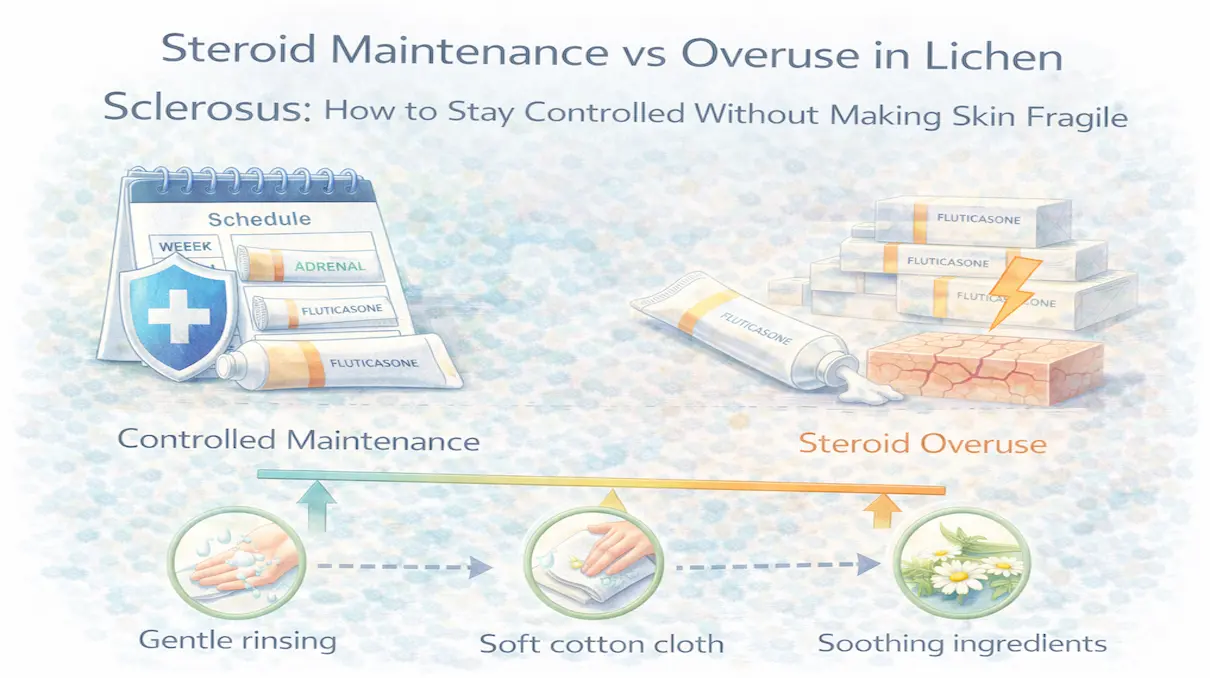
Over Cleaning Often Leads to Unnecessary Steroid Escalation
This is one of the most important downstream effects.
When irritation from cleansing mimics inflammation:
- symptoms feel worse
- people assume LS is flaring
- stronger steroids are used more often
In many of these cases:
- inflammation is mild
- the main driver is barrier damage
At that stage:
- mometasone is often sufficient
- hydrocortisone may be enough during low grade activity or tapering
Escalation to clobetasol should be reserved for clearly active, strong inflammation, not cleansing induced irritation.
Over cleaning quietly increases steroid fear by creating problems steroids were never meant to solve.
Drying and Wiping Matter as Much as Washing
Cleansing problems are often worsened by how the skin is dried.
Rubbing with towels or repeated wiping:
- creates micro trauma
- increases nerve irritation
- worsens barrier disruption
Many flares blamed on “disease progression” are actually mechanical injury layered on top of over cleaning.
Gentle patting or air drying reduces this load dramatically.
Why Reducing Cleaning Often Improves Symptoms
When people reduce washing frequency and intensity, they often notice:
- less burning
- fewer “random” symptoms
- better tolerance to movement
- reduced need for strong steroids
This is not placebo.
It reflects:
- barrier lipid recovery
- reduced nerve activation
- lower immune re triggering
The skin becomes more predictable again.
Cleaning During Flares vs Between Flares
During flares, LS skin is at its most fragile.
At this stage:
- minimal washing
- lukewarm water
- no unnecessary products
Between flares, routines should remain stable, not intensified “just in case.”
LS skin responds better to consistency than vigilance.
What “Clean” Should Feel Like
After washing, LS skin should feel:
- neutral
- calm
- unchanged
Not tight.
Not burning.
Not “extra clean.”
If washing leaves a sensation, it is usually doing too much.
Where Barrier Products Fit In
After gentle cleansing once the skin is fully dry barrier products protect what washing cannot.
Commonly helpful options include:
- petrolatum (Vaseline) for friction protection
- Cicalfate when the surface feels irritated or raw
- Cicaplast B5+ for lighter daily barrier support
- zinc based barriers, VEA Lipogel, Vitamono EF during maintenance
These do not treat LS.
They prevent cleansing related re-injury.
Final Thought
Overcleaning does not protect lichen sclerosus skin.
It destabilizes it.
Reducing unnecessary cleansing often:
- lowers daily irritation
- improves steroid response
- decreases reliance on high potency treatment
Medication controls inflammation.
Daily habits decide whether that control holds.