Why Lichen Sclerosus Can Burn Even Without Visible Changes
One of the most confusing and frightening experiences in lichen sclerosus is this:
The skin looks calm.
No obvious redness.
No new tears.
No visible progression.
And yet the burning, stinging, or raw sensation is still there.
Many people are told some version of:
“Everything looks fine.”
Or worse: “It’s probably anxiety.”
My view is different and grounded in biology:
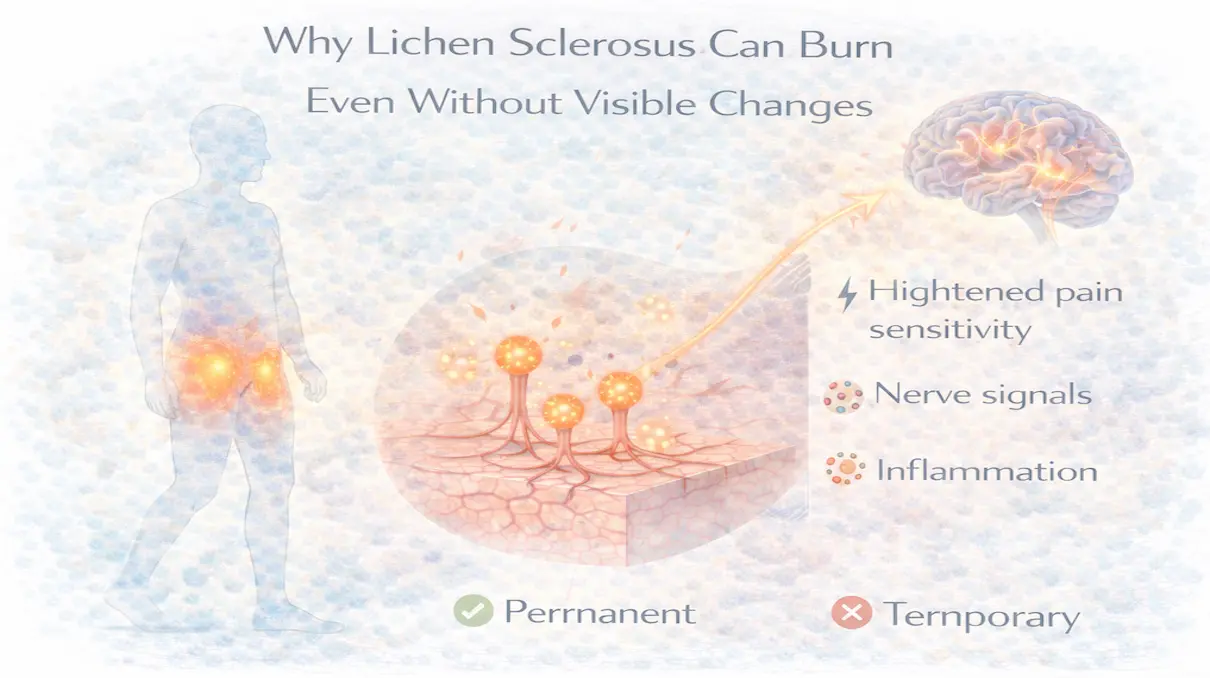
In lichen sclerosus, pain and burning do not require visible skin damage.
They are often driven by microscopic inflammation, nerve sensitization, and barrier dysfunction that cannot be seen with the naked eye.
Once you understand this, the fear drops and management becomes much more effective.
Visible Skin Changes and Symptoms Are Not the Same Thing
LS is not just a surface condition.
Even when the skin looks normal, several processes may still be active underneath:
- low-grade immune signaling
- sensitized nerve endings
- impaired skin barrier
- altered local blood flow
Symptoms reflect how the skin is signaling, not only how it appears.
This is why relying only on visual inspection leads to confusion and often dismissal.
Residual Inflammation Can Persist After the Skin Calms
Topical steroids often improve:
- redness
- whitening
- obvious textural changes
But inflammatory signaling can persist microscopically.
Cytokines commonly involved in LS such as TNF-α, IL-1β, and interferon-γ (IFN-γ) can remain elevated even after the skin looks better.
These cytokines:
- irritate nerve endings
- lower pain thresholds
- amplify sensation
The result is burning without visible inflammation.
This does not mean treatment failed.
It means inflammation has quieted but not fully resolved yet.
Nerve Sensitization: Why the Skin Feels “Overreactive”
Repeated inflammation trains the nervous system.
Over time, nerves in LS affected skin may:
- fire more easily
- overreact to friction
- interpret normal sensations as painful
This is called peripheral sensitization, and in some cases contributes to broader neuro immune amplification.
Important clarification:
This is not permanent nerve damage.
It is a reversible functional state but it calms slowly, not instantly.
That’s why aggressive escalation often backfires, while consistency helps.
Barrier Dysfunction Can Cause Burning Without Redness
LS skin often has an impaired barrier even when it looks intact.
When the barrier is weak:
- water evaporates too quickly
- nerve endings sit closer to the surface
- friction causes disproportionate discomfort
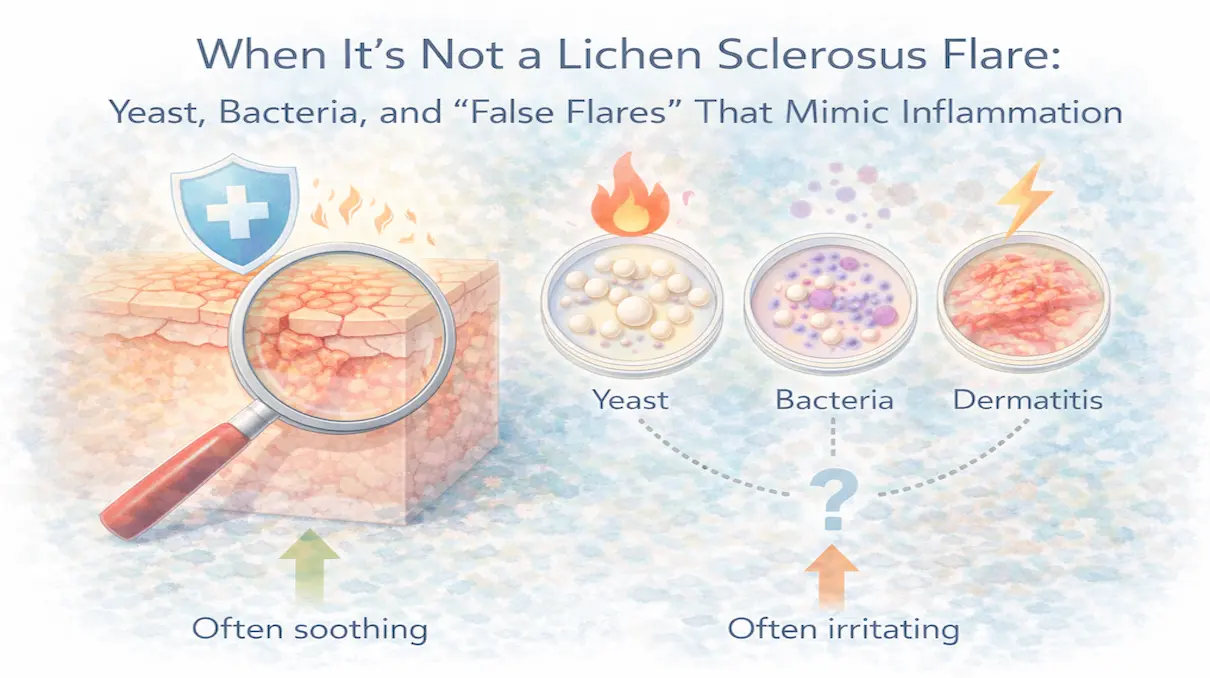
This explains why burning often appears:
- after washing
- after walking or sitting
- after sex
- with no visible injury at all
Barrier damage is invisible but biologically very real.
This is where barrier products matter, not as treatment, but as protection.
Why Steroids Don’t Always Fix This Immediately
Steroids suppress inflammation.
They do not instantly normalize:
- nerve sensitivity
- lipid barrier structure
- mechanical tolerance
So people often experience this phase:
- skin looks calm
- steroids “worked”
- burning persists
This is where many panic and escalate.
But escalating potency during this phase often:
- increases fragility
- worsens barrier recovery
- prolongs sensitivity
At this stage, stabilization beats escalation.
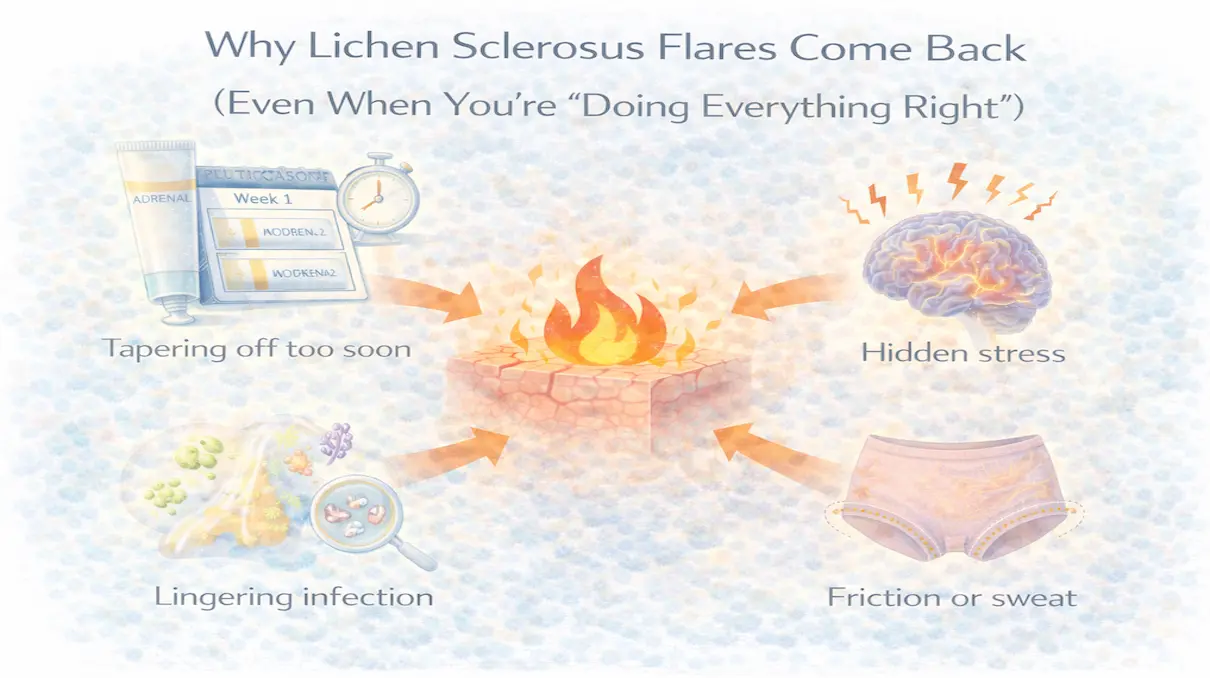
Common Triggers When the Skin Looks Normal
Burning without visible change is often triggered by:
- friction from walking, sitting, or clothing
- moisture imbalance or sweating
- over washing
- repeated wiping
- stopping steroids abruptly
- anxiety-driven over checking
These do not create lesions, they irritate already sensitized tissue.
How This Phase Is Best Managed
This phase responds best to boring, predictable care:
- consistent routines
- friction reduction
- barrier protection after steroid absorption
- gradual tapering rather than abrupt stops
This is where simple, inert products often outperform “active” ones:
- petrolatum (Vaseline) for friction protection
- Cicalfate when the surface feels raw or irritated
- Cicaplast B5+ during recovery and maintenance
- zinc-based barriers, VEA Lipogel, Vitamono EF for supportive protection
Rotating aggressively or “trying something new” usually makes things worse.
Why Burning Alone Does NOT Mean Progression
This is critical:
Burning is a functional symptom.
Progression is structural.
You can have:
- significant burning
- stable structure
- no new scarring
Many people experience long periods of sensory symptoms without meaningful anatomical change especially when inflammation is controlled.
Understanding this prevents unnecessary fear and overtreatment.
When Burning Needs Re Evaluation
Burning should be reassessed if:
- symptoms steadily worsen over weeks
- new visible changes appear
- tearing increases
- pain becomes constant despite stable care
In those cases, inflammation may be reactivating and treatment needs adjustment.
Final Thought
Lichen sclerosus can burn even when the skin looks normal because LS is not only a surface disease.
It lives at the intersection of:
- immune signaling
- nerve sensitivity
- barrier integrity
- mechanical stress
Understanding this:
- removes panic
- prevents overtreatment
- shifts focus to stabilization
And stabilization not escalation is what improves long term outcomes.