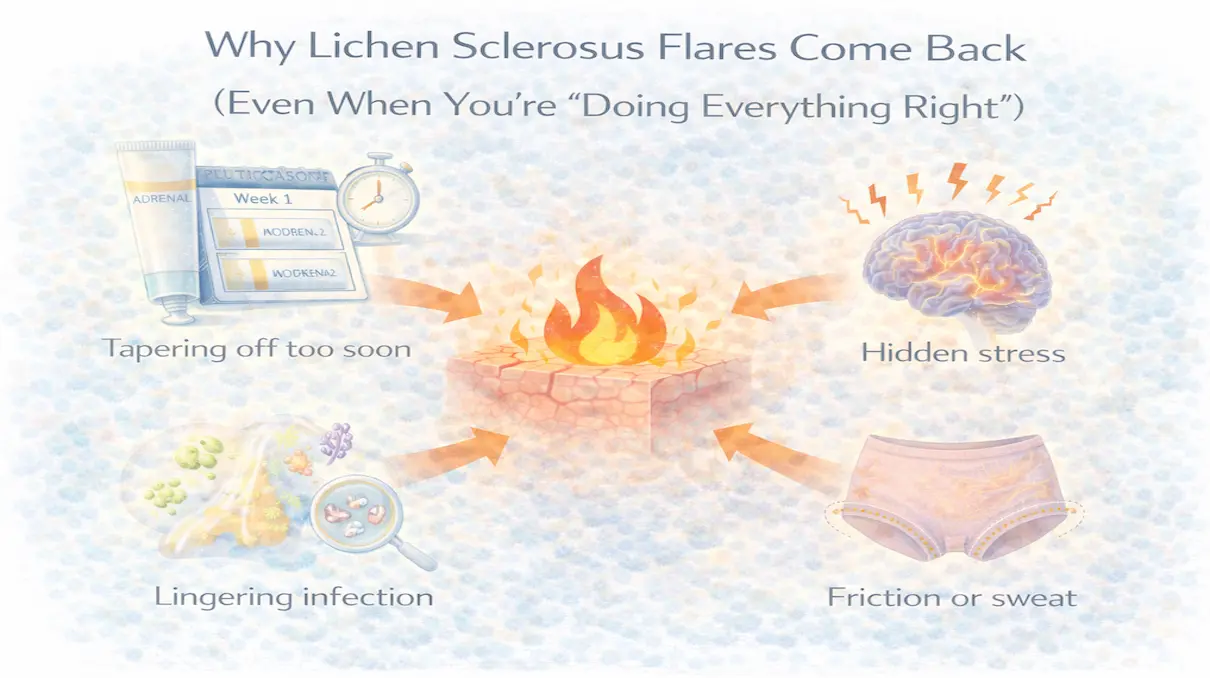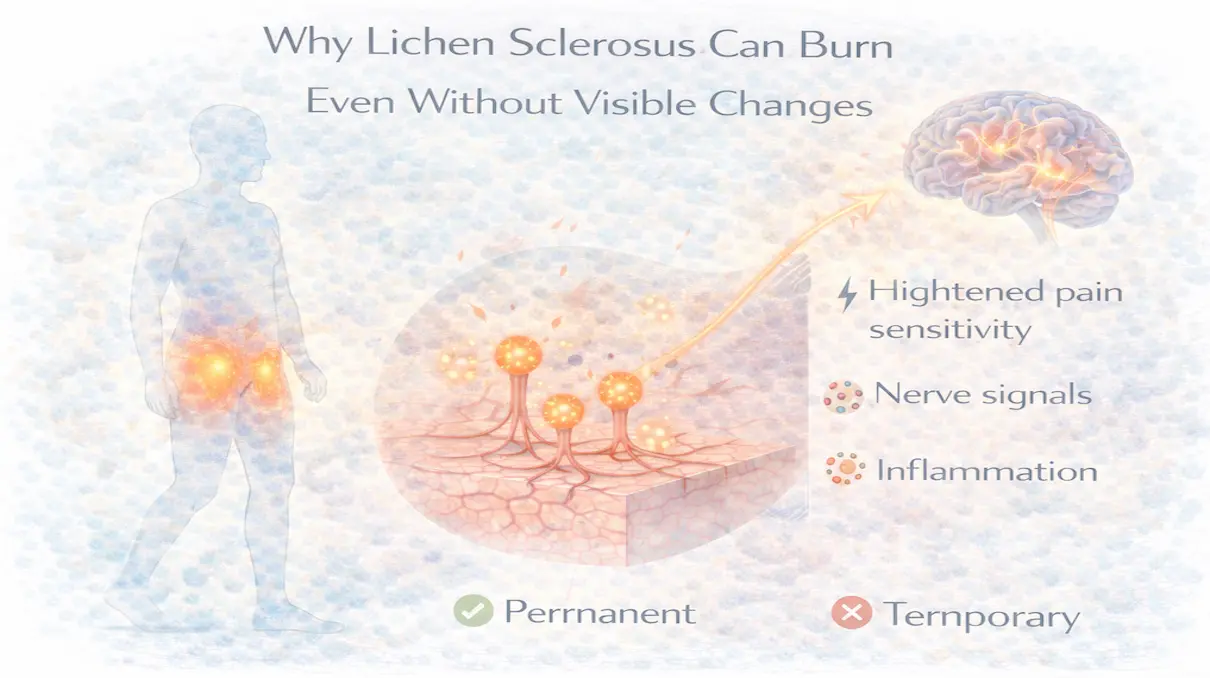
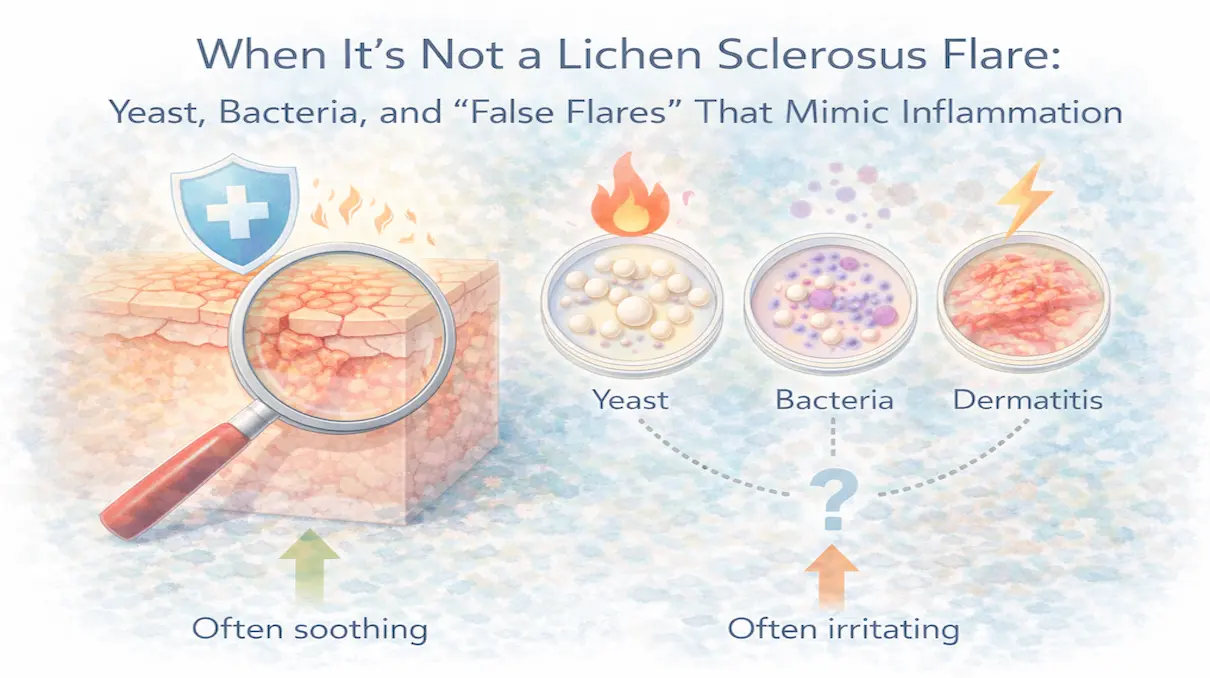
When It’s Not a Lichen Sclerosus Flare: Yeast, Bacteria, and “False Flares” That Mimic Inflammation
One of the most common patterns I see in people with lichen sclerosus is this:
Symptoms rise →
they assume it’s a flare →
they reach for a steroid.
Sometimes that’s exactly the right move.
But there’s a major problem in real life that almost nobody explains:
Not every bad episode is a true LS flare.
Yeast overgrowth, bacterial imbalance, moisture irritation, and contact dermatitis can create symptoms that feel identical to LS inflammation, even when immune activation is not the main driver.
If you treat the wrong problem with the right medication, you can stay stuck for months.
This article explains how “false flares” happen, why they feel the same, and how to think about them clearly without paranoia or over treatment.
Why Yeast and Bacteria Can Feel Exactly Like Lichen Sclerosus
The classic symptoms of LS include:
- burning
- itching
- soreness
- fissures or micro tears
- sensitivity after washing or wiping
Those exact same sensations can also come from:
- yeast (Candida) irritation
- bacterial imbalance
- moisture maceration (skin staying damp)
- harsh cleansers or wipes
- fragrance or preservative sensitivity
Your nervous system cannot reliably tell the difference between:
- immune driven inflammation
and
- chemical or microbial irritation
The sensation can be identical, even when the cause is completely different.
The Biology: Two Different “Inflammations” That Feel the Same
Immune Driven LS Inflammation
This is what topical steroids are designed to suppress.
It involves:
- immune activation inside the skin
- cytokines such as IFN-γ, TNF-α, and IL-1β
- chronic barrier fragility and re-triggering
This is where:
- clobetasol (when inflammation is strong)
- mometasone (when moderate)
- hydrocortisone (when low or tapering)
make biological sense.
Irritant or Microbial Driven Inflammation
This is not autoimmune activation.
It’s a local tissue response to:
- microbial metabolites
- moisture imbalance
- chemical irritation
- barrier breakdown
Steroids can temporarily reduce redness or burning here
but they do not remove the trigger.
That’s why symptoms may return immediately or even feel worse.
Why Steroids Sometimes Make a “False Flare” Worse
This experience confuses and scares many people:
“I used the steroid and it felt worse.”
Possible reasons include:
- steroids suppress immune response but do not kill yeast or bacteria
- reduced local immune vigilance allows overgrowth to persist
- fragile skin + irritation + steroid use can feel harsher
- heavy occlusion applied too early can increase moisture and maceration
This does not mean steroids are bad.
It means steroids are not the right tool when the main driver is microbial or irritant.
The Most Common “False Flare” Drivers
Moisture and Maceration (The Most Overlooked Trigger)
This is extremely common and underestimated.
Moisture problems come from:
- sweating
- tight or synthetic underwear
- prolonged sitting
- not drying well after washing
- heavy occlusion applied repeatedly
- layering barrier creams on already damp skin
Damp skin becomes:
- softer
- more fragile
- more friction-sensitive
- easier to irritate by microbes
Maceration can cause burning and fissures that look like LS activity,
but the real problem is a wet environment.
Yeast Overgrowth (Candida)
Yeast irritation can cause:
- intense itching
- burning
- redness
- soreness after sex
- a raw or “angry” feeling
Important point:
Yeast does not need to be massive to cause symptoms in LS.
When the barrier is fragile, even a mild imbalance can feel severe.
Bacterial Imbalance
Bacterial irritation may present as:
- burning or soreness
- increased odor
- discharge (more relevant in vulvar cases)
- sensitivity after washing or wiping
In male genital skin, this often shows as:
- glans irritation
- dampness-related soreness
- sensitivity in folds or under foreskin if present
Again, the sensation can closely mimic LS inflammation.
Contact Dermatitis (Products)
This is one of the biggest reasons people stay inflamed.
Common triggers include:
- “intimate washes” with surfactants
- repeated antiseptic use (chlorhexidine, iodopovidone)
- fragranced wipes
- essential oils
- harsh preservatives
- some “natural” extracts that sting on mucosa adjacent skin
If a product stings:
- immediately
- or
- increasingly over 2–5 days
that is a strong sign the product is part of the problem.
How to Tell a True LS Flare From a False Flare (Patterns, Not Perfection)
There is no perfect test, but there are patterns.
More suggestive of a true LS flare:
- gradual rise over days to weeks
- tightening or whitening changes
- texture changes
- fissures linked to fragility rather than dampness
- symptoms respond predictably to steroids over time
- discomfort feels “deep” rather than surface only
More suggestive of a false flare:
- sudden burning after a new product
- itching that spikes at night or after sweating
- symptoms worse with moisture or occlusion
- symptoms worse after antibiotics or illness (yeast risk)
- symptoms worse after heavy washing
- steroid helps briefly but symptoms return quickly
- strong surface sting rather than deep discomfort
This is not about diagnosing yourself perfectly.
It’s about noticing when the pattern doesn’t fit “pure LS inflammation.”
Why Hygiene Fixes Sometimes Beat “More Treatment”
Many people accidentally improve by:
- washing less aggressively
- drying more carefully
- simplifying products
- reducing dampness and friction
They assume the LS “went away.”
What actually happened is:
- the irritant or microbial driver dropped
- the skin stopped getting re-triggered
- immune signaling calmed naturally
This is why daily care and environment matter so much.
The Role of Barrier Products in False Flares
Barrier products can help or worsen things, depending on timing.
Barrier products commonly used include:
- petrolatum / Vaseline
- Cicalfate
- Cicaplast Baume B5+
- VEA Lipogel or Vitamono EF
- zinc-based barrier creams
Barrier protection helps when:
- friction is the main trigger
- the skin is dry and reactive
- applied after the skin is fully dry
Barrier protection can worsen symptoms when:
- applied thickly to damp skin
- trapping sweat or moisture
- layered repeatedly without allowing drying
The rule is not “never occlude.”
The rule is: occlusion works best in a controlled, dry environment.
A Practical Way to Think When Symptoms Rise
When symptoms increase, there are only a few real possibilities:
- True LS flare
- Immune activation rising → steroid cycling plan makes sense
- False flare
- Moisture, irritation, yeast, bacteria → fix environment first
- Both at the same time
- Very common: LS fragility + moisture or yeast together
This is why some episodes feel “different” from others.
Warning Signs That Need Medical Review
Seek medical evaluation if you notice:
- significant discharge or strong odor (vulvar cases)
- fever or systemic symptoms
- severe pain with urination
- ulcers, spreading redness, or rapidly worsening skin
- persistent or uncertain lesions
- symptoms that never stabilize despite simplification
This is not fear based, it’s basic safety.
Final Thought
Not every bad week is a true lichen sclerosus flare.
Sometimes it’s yeast, bacteria, moisture, or irritation
and it feels exactly the same.
One of the biggest upgrades in long term control is learning this simple rule:
Treat the driver, not just the sensation.
When you stop fighting the wrong battle, your treatment finally starts to hold.