Is Lichen Sclerosus Progressive? What Progression Really Means
“Is lichen sclerosus progressive?”
This is one of the first questions people ask, and one of the most poorly explained.
Some are told it always worsens.
Others are told treatment stops it completely.
Many are left monitoring every sensation, convinced that damage is inevitable.
My view based on biology, clinical patterns, and long-term observation is more nuanced and far less frightening:
lichen sclerosus is not automatically progressive.
It progresses only under certain conditions.
Understanding those conditions changes everything.
What “Progressive” Actually Means in Lichen Sclerosus
Progressive does not mean steady, unstoppable decline.
LS does not behave like:
- a degenerative neurological disease
- a continuously spreading cancer
It behaves like a chronic inflammatory skin condition with variable activity.
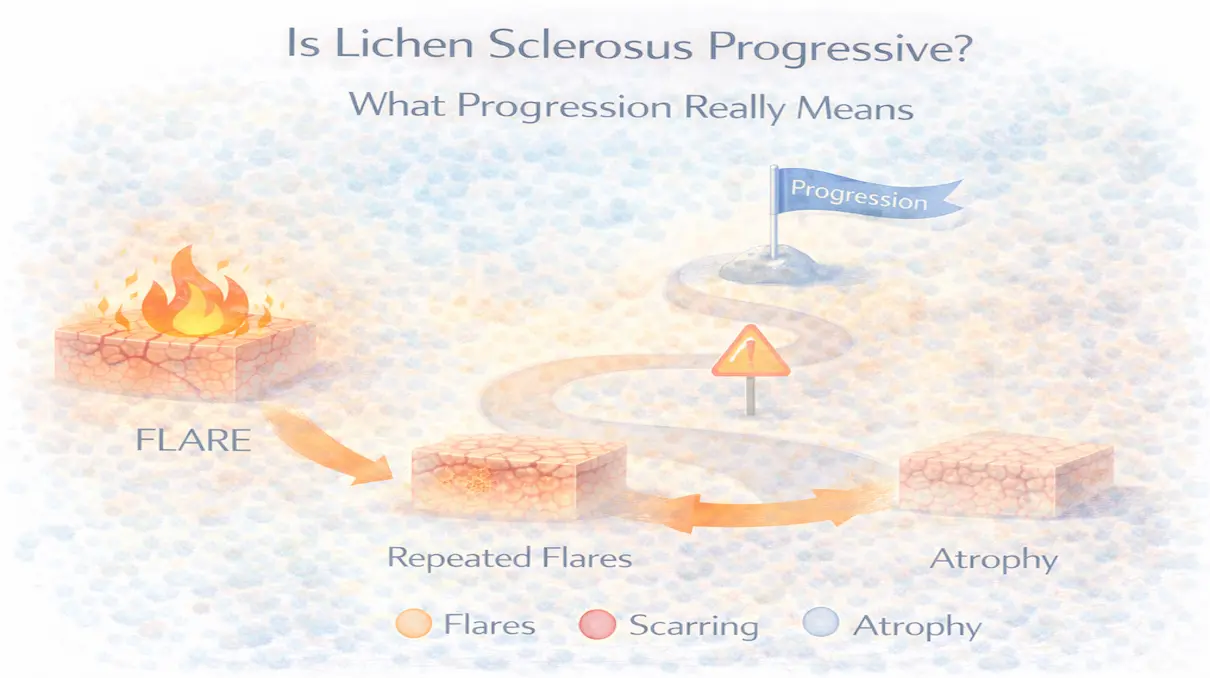
Progression happens when:
- inflammation remains active
- inflammation reactivates repeatedly
- inflammation is untreated or poorly controlled over time
Progression is conditional, not guaranteed.
Inflammation Drives Progression — Not Time
This is the most important concept.
Lichen sclerosus does not progress simply because years pass.
It progresses when inflammatory signaling, involving pathways such as IFN-γ, TNF-α, and IL-1β stays active long enough to damage tissue structure.
When inflammation is controlled:
- tissue damage slows
- scarring risk drops
- many changes stabilize
This is why people diagnosed early and treated consistently often show minimal long term structural change.
Time alone is not the enemy.
Uncontrolled inflammation is.
Why Early Phases Often Look Worse Than Later Years
Many people notice something surprising:
Early photos or memories look dramatic.
Later years often feel more stable.
This happens because:
- early inflammation is often intense and untreated
- diagnosis leads to targeted suppression
- daily care and barrier protection improve
Ironically, progression risk is often highest before diagnosis, not after it.
Once inflammation is understood and managed, the trajectory usually improves.
Scarring Is Not the Same as Progression
This distinction is rarely explained and causes unnecessary fear.
Some changes reflect:
- past inflammation
- tissue remodeling
- loss of elasticity
These changes may persist visually but do not mean the disease is actively worsening.
Stable scarring is not progression.
Ongoing inflammatory damage is.
Confusing the two leads to panic and panic often worsens symptoms.
Why Symptoms Can Worsen Without Structural Progression
Another common trap: assuming pain equals damage.
Pain, burning, or tightness can increase even when tissue structure is stable.
This is often due to:
- nerve sensitization
- fragile barrier function
- repeated mechanical irritation
- stress driven neuro immune amplification
Symptoms reflect activity, not always damage.
This is why some people feel worse even while their skin looks unchanged and why escalating treatment blindly doesn’t always help.
Does Treatment Stop Progression?
Treatment does not “cure” LS, but it changes the trajectory.
Correct steroid use:
- suppresses inflammatory signaling
- reduces immune driven tissue injury
- lowers scarring risk
Daily maintenance:
- barrier protection (Vaseline/petrolatum, Cicalfate, Cicaplast B5+, zinc barriers, VEA Lipogel, Vitamono EF)
- friction reduction
- predictable routines
Together, these convert LS from an unpredictable disease into a manageable condition.
Progression risk drops when the system stays calm.
When Progression Is More Likely
Progression risk increases when:
- inflammation remains untreated or under treated
- steroids are avoided out of fear
- friction and micro trauma persist daily
- flares are ignored instead of managed
None of these are inevitable.
They are modifiable factors, not destiny.
Why LS Progression Looks Different in Different People
LS is not uniform.
Some people experience:
- intense early flares, then long stability
Others:
- slow changes over many years
Factors include:
- immune sensitivity
- hormonal environment
- genetics
- mechanical stress exposure
- quality of maintenance care
This variability makes predictions difficult, but risk reduction very real.
What Stability Actually Looks Like
Stability does not mean:
- zero sensation
- perfect looking skin
- never using treatment
It means:
- inflammation stays controlled
- flares are shorter and milder
- tissue changes slow or stop
- daily life feels predictable
That is a successful long term outcome.
Final Thought
Lichen sclerosus is not automatically progressive.
Progression depends on inflammation, not time.
Not diagnosis.
Not fear.
With intelligent steroid use, proper tapering, consistent barrier protection, and mechanical awareness, many people live decades with minimal structural change.
Understanding this reduces panic
and reducing panic is often part of treatment.