Can Lichen Sclerosus Go Into Remission? A Complete Guide to Reaching and Sustaining Stability

Can Lichen Sclerosus Go Into Remission? A Complete Guide to Reaching and Sustaining Stability
When you receive a lichen sclerosus diagnosis, one of the first things most people are told is that it is chronic. Lifelong. A condition you manage, not one you cure. That information is accurate. What is almost always left unsaid is what chronic actually means for daily life, and here the picture is considerably more hopeful than most patients initially understand.
Chronic does not mean constantly active. Many patients with lichen sclerosus reach long periods of genuine stability, sometimes months or years, where symptoms are minimal, the skin behaves predictably, and the disease stops dominating their awareness. That state is called remission. It is real, it is achievable for many patients, and understanding what it means biologically, and what it takes to reach and sustain it, is one of the most useful things you can learn about this disease.
This article covers all of it. What remission actually is at the biological level. What the evidence says about achieving it. Why the disease keeps coming back when you think you have it under control. What the feedback loops are that drive that cycle. And the specific daily framework that determines whether stability holds or unravels.
In this article
- What remission actually means in lichen sclerosus
- The four phases of LS: where remission fits
- What the research says about achieving remission
- The biological reason flares keep returning
- What immune memory means for long term management
- What drives stability, and what disrupts it
- Early warning signals: how to catch a relapse before it starts
- The three mode management framework
- What a remission maintenance routine actually looks like
- Maintenance medication during remission: the evidence
- The emotional dimension of remission
- Realistic expectations across different patients
- Frequently asked questions
What remission actually means in lichen sclerosus
Start here, because the word carries different weight in different diseases, and in lichen sclerosus it has a precise biological meaning that is worth being clear about.
Remission in LS is not the absence of disease. The underlying biological susceptibility, the immune system's tendency to target vulvar or anal skin tissue, does not disappear. What changes is the activity level of that immune process. During remission, inflammatory signaling is low, the skin barrier is relatively intact, nerve sensitivity has calmed, and the tissue is not actively progressing toward more structural damage.
Importantly, remission in LS is not a passive state. It does not happen on its own and then maintain itself. It is produced by, and depends on, specific biological conditions being consistently maintained. When those conditions erode, the disease reactivates. Every patient who has managed LS for years understands this pattern at some level: feel good, stop being vigilant, flare. What most patients are never told is why that cycle happens, and what is going on biologically between the moment they feel well and the moment symptoms return.
The key distinction most patients are never given: remission means the disease is not currently active, not that it has resolved. Treating these as the same thing is the most reliably documented cause of relapse. The treatment is what is producing the stability. Stopping the treatment removes the factor producing the output.
The four phases of LS: where remission fits
Lichen sclerosus does not behave as a single uniform state. It moves through biologically distinct phases, and understanding which phase the skin is in at any given moment determines what kind of management is appropriate, and what will make things worse.
Phase 1
Active inflammatory flare
The immune cascade is active. Cytokines including TNF-α, IL-1β, and IL-6 are driving itch, burning, redness, and tissue reactivity. The skin surface is intact but immunologically activated. Anti inflammatory treatment has its clearest role here.
Phase 2
Erosive / barrier broken
Inflammation has disrupted the surface architecture. The skin is raw, fragile, stinging on contact. Fissures may be present. Potent actives on open skin worsen things. Barrier protection becomes the priority, not immunosuppression.
Phase 3
Fibrotic remodelling
TGF-β driven collagen accumulation is producing tightness, pallor, and reduced elasticity. This can occur silently even during apparently stable periods. Structural monitoring matters here because symptoms may be minimal while the tissue is changing.
Phase 4
Remission: fragile stability
All three processes are at low activity simultaneously. Symptoms are minimal. The skin is not in an erosive state. The feedback loops are running at low level, not at zero. This is the phase patients are working toward, and the one that requires active maintenance to persist.
The critical understanding about Phase 4 is what it isn't. It is not resolved disease. It is not normal skin. LS affected tissue in remission retains an altered architecture: thinner epidermis, different lipid matrix organization, altered nerve sensitivity profiles. This means it is not the same as unaffected skin. The immune memory established by previous inflammatory episodes persists. The feedback loops are running at low activity, not at zero. The trigger amplification loop, through which accumulated activity lowers the threshold at which any stimulus can restart the system, remains in place.
Remission is a balance, not an absence. It is maintained by the factors that produced it.
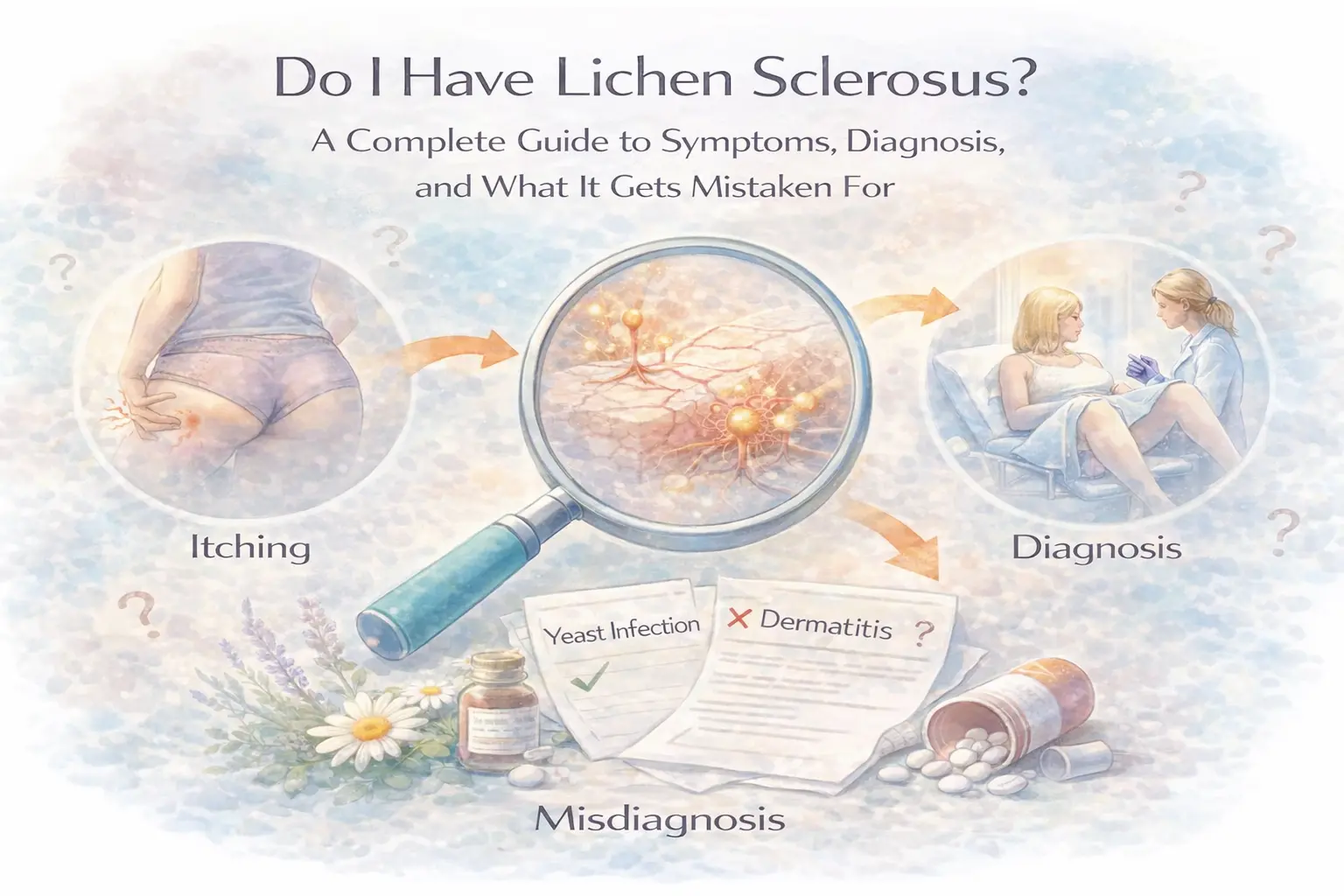
Related: Do I Have Lichen Sclerosus? A Complete Guide to Symptoms, Diagnosis, and What It Gets Mistaken For
What the research says about achieving remission
The evidence on long term LS outcomes is consistent in its direction, even if the specific numbers vary between studies. Here is what the research shows.
Evidence summary
Patients who begin treatment early and maintain it consistently, including during symptom free periods, develop fewer structural changes, experience longer stable intervals, and have significantly lower rates of functional complications over time than patients who treat reactively only during flares.
Spontaneous resolution is rare in adults
In children with LS, there are documented cases of symptoms improving significantly around puberty, possibly linked to hormonal changes. In adult women, spontaneous resolution without treatment is uncommon. The disease can quieten during certain periods, and remissions occur even without rigorous management, but relying on spontaneous resolution as a strategy is not supported by the evidence. What the research consistently shows is that managed remission is more durable than spontaneous remission.
Consistent treatment significantly reduces structural progression
Studies following patients over years have shown that those who maintain consistent anti inflammatory treatment, even at low frequency between flares, develop fewer structural changes over time. The scarring, fusion, and architectural changes that represent the most feared long term consequences of LS are significantly associated with inadequate or inconsistent treatment. This is one of the most important findings in the LS literature, and one that is still not communicated clearly enough at diagnosis.
The biological explanation is important to understand. LS involves three partly independent processes: inflammation, fibrosis, and barrier disruption. Treating only the inflammatory component during active flares leaves the fibrotic process unaddressed. Fibrosis can advance even during apparently well controlled periods, driven by sub threshold TGF-β signaling that does not produce symptoms the patient can feel. Early and consistent treatment keeps inflammatory activity low enough that the fibrotic process receives less of the input it needs to progress.
Remission is achievable for many patients
Multiple cohort studies have reported that a significant proportion of patients, and in some studies the majority, achieve periods of clinical remission with appropriate treatment. "Appropriate" means consistent, phase matched, and maintained even during quiet periods. The patients who reach the longest stable intervals are almost always those who started early, understood their disease well, and maintained their management approach when they felt good, not only when they felt sick.
Stopping treatment during remission reliably leads to relapse
This is the finding that surprises patients most. Studies consistently show that stopping treatment when symptoms resolve accelerates the return of disease activity. The temptation when symptoms clear is to stop everything. The evidence says: don't. The disease did not go away; the treatment was keeping it quiet.
One of the most clearly documented patterns in LS is the progressive compression of flare free intervals over time when treatment is stopped between episodes. Flares that once appeared every four or five months begin appearing every six weeks. Patients typically attribute this to the disease getting worse or becoming treatment-resistant. In most cases, what has happened is simpler: each incomplete cycle has left the barrier slightly more compromised, nerve sensitization slightly more entrenched, and the trigger amplification loop slightly more active. The threshold has lowered incrementally.
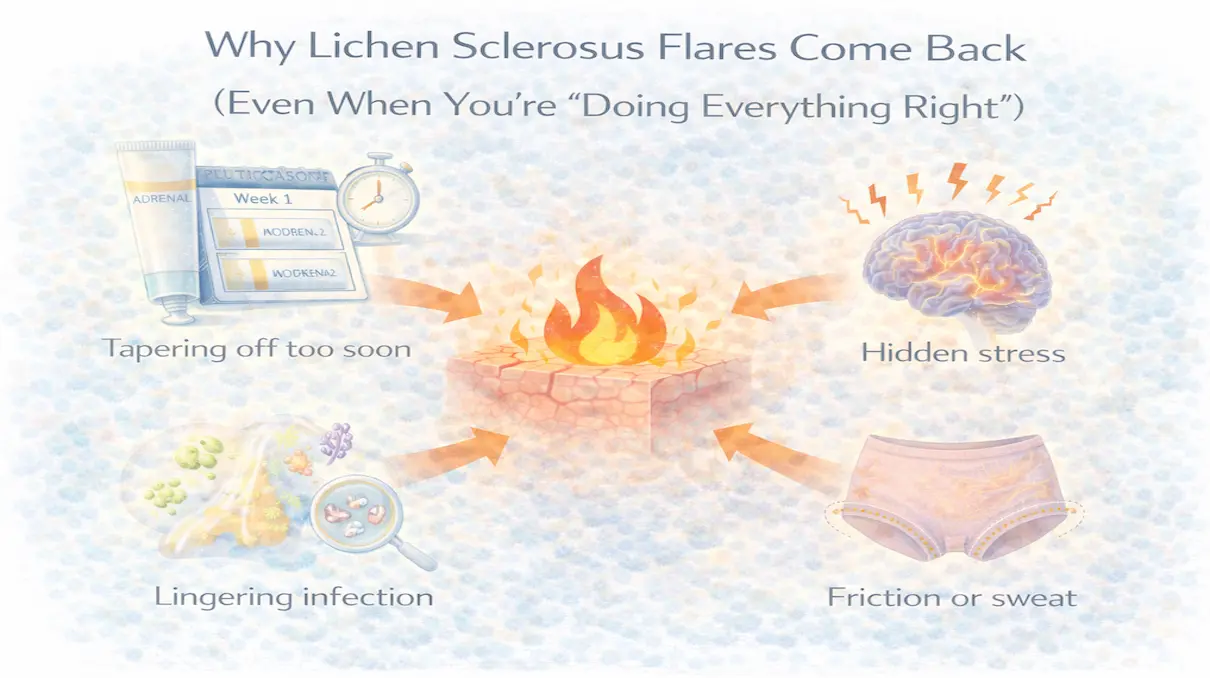
Related: Why Lichen Sclerosus Flares Keep Coming Back, Even When You're Doing Everything Right
The biological reason flares keep returning
Understanding why remission ends, not just that it ends, is one of the most useful pieces of knowledge a patient with LS can have. The answer lies in what the book calls the five feedback loops that sustain the disease.
LS does not come back randomly. It comes back because biological loops are running continuously beneath the visible surface of the disease, loops that sustain each other and that require more than interrupting any single one of them to stop.
The five feedback loops in LS
Loop 1: Inflammation: Immune cells release inflammatory cytokines → which recruit more immune cells → which release more cytokines. Anti inflammatory treatment interrupts this loop. But if the other four loops continue running, this loop will be re-established from outside.
Loop 2: Barrier damage: Inflammation disrupts barrier integrity → which allows mechanical forces and irritants to generate immune activation → which produces more inflammation. This loop can sustain itself independently of the primary autoimmune signal.
Loop 3: Neuroimmune itch: Inflammatory mediators sensitize C-fibers, lowering the itch threshold → itch produces scratching → scratching disrupts the barrier and activates immune responses → further sensitizing the C-fibers. Once established, this loop can run primarily through the scratching to barrier damage pathway, with or without primary inflammatory activation.
Loop 4: Fibrosis: Tissue injury from inflammation or micro trauma activates TGF-β signaling → instructing fibroblasts to deposit collagen → making tissue stiffer and more prone to micro injury from normal movement → generating more TGF-β signaling. This loop operates on the slowest timescale and produces the most durable consequences.
Loop 5: Trigger amplification: As each loop runs, it contributes to a general lowering of the tissue's activation threshold. Stimuli that would have passed without consequence earlier in the disease course now reliably cross the threshold required to activate one or more of the other loops. This is not a single biological cascade. It is the emergent property of the first four loops operating together over time.
The practical implication is direct: anti inflammatory treatment interrupts loop 1 effectively. But if loop 2 is running simultaneously, the inflammation loop will be re-established as soon as pharmacological suppression is reduced, because the barrier loop's own activity level has not changed. If the neuroimmune loop is active, scratching continues producing barrier disruption and immune reactivation through a pathway that cytokine suppression does not reach. If the fibrosis loop has been advancing quietly, the tissue's mechanical vulnerability has increased, making reactivation from barrier micro-injury easier with each cycle.
Each loop left running while another is addressed represents a pathway through which the addressed loop will be restarted. This is why addressing one loop, which is what happens when a steroid course is used in isolation, produces temporary relief that reliably ends. The system doesn't need all five loops simultaneously active at high levels. It needs only enough combined loop activity to exceed the activation threshold, and the trigger amplification loop has been progressively lowering that threshold.
Durable stability requires reducing activity across multiple loops simultaneously. Not necessarily with a different treatment for each, but with management broad enough that no single loop's continued activity is sufficient to restart the system.
Related: The Steroid Trap in Lichen Sclerosus: Why Repeated Courses Stop Working, and What to Do About It
What immune memory means for long term management
There is a specific biological mechanism in LS that explains why the same triggers become more effective over time at provoking flares, and why achieving remission becomes harder if too many active cycles accumulate before consistent management begins.
Immune cells that have participated in inflammatory episodes do not return to a neutral state when inflammation resolves. They retain an altered activation profile: a lower threshold for reactivation in response to the same stimuli that provoked the original response. In LS, this becomes a significant liability. Triggers that would have passed without consequence earlier in the disease course can become sufficient to restart the cytokine cascade.
One mechanism that may explain this location specific immune priming involves tissue resident memory T cells, which unlike circulating immune cells take up long term residence in the tissue where they were first activated and remain there after inflammation resolves. When the tissue encounters a familiar trigger, these cells can reactivate rapidly because they are already in place. This may help explain why LS tends to return in the same location, why reactivation can occur quickly, and why the retriggering threshold appears to fall over repeated episodes.
Why this matters: The earlier treatment begins and the more consistently it is maintained, the fewer active inflammatory cycles accumulate, and the less immune priming occurs. Patients who begin treatment at or near diagnosis and maintain it consistently typically have an easier time sustaining remission than patients who accumulate years of undertreated cycles before finding an approach that works.
This is not a reason for despair if treatment began late. It is a reason to understand that consistent maintenance during remission is doing something real. It is not only suppressing symptoms you can't feel, it is preventing the immune memory and sensitization that would make the next cycle harder to manage.
What drives stability, and what disrupts it
Remission is not something that just happens to you. It is the result of specific biological conditions being maintained, and understanding those conditions makes it far easier to protect them.
What creates the conditions for remission
Low inflammatory activity. The primary driver of LS symptoms and progression is immune mediated inflammation. Remission requires that this inflammatory signaling be consistently suppressed to a low baseline. This is why maintenance anti inflammatory treatment matters even when you feel completely well. It keeps loop 1 activity below the threshold where it can self sustain.
An intact, functional skin barrier. The epidermal barrier in LS affected tissue is structurally thinner and more permeable than normal skin, even during remission. When the barrier is reasonably intact, it shields immune cells and sensitized nerve endings from mechanical and chemical contact. When it breaks down, everything else becomes more potent. Barrier protection during remission is not comfort care. It is one of the core conditions that allows loop 2 to stay quiet.
Reduced trigger load below the threshold. Even in remission, LS skin has a lower activation threshold than normal skin. Trigger amplification means that stimuli which were previously tolerated can become sufficient to initiate a loop cycle as the disease matures. Keeping triggers below that threshold is what separates a stable month from a relapse. This does not require eliminating every possible trigger. It requires knowing your personal profile well enough to manage cumulative load intelligently.
Hormonal stability. Estrogen supports the structural quality of vulvar tissue, including epithelial thickness, mucosal hydration, collagen maintenance, and local vascular supply. When estrogen declines, the tissue becomes more prone to micro injury and slower to recover. This is not the inflammatory process of LS, but it affects the resilience of the terrain in which the disease operates. Post menopausal patients who do not address the hormonal modifier often find their remission more fragile than those who use local estrogen support alongside their anti inflammatory management.
Related: Lichen Sclerosus and Hormones: Estrogen, Menopause, and Why Management Gets Harder With Age
What disrupts remission
Relapses during otherwise stable periods almost always trace back to one or more of the following:
- Stopping maintenance treatment is the most common and most preventable cause. The skin looks and feels normal, so the medication seems unnecessary. It isn't. The treatment is what is producing the normality.
- Trigger accumulation means not one dramatic event but a stack of small stressors over days that eventually crosses the activation threshold. Friction, a new product, a stressful week, a minor infection. Any one alone might not trigger a flare, but layered together, they often do.
- Barrier breakdown from over washing, harsh products, or dryness going unaddressed. Once the barrier is compromised, loop 2 reactivates and starts feeding loop 1.
- Hormonal transitions such as menstrual cycle shifts, perimenopause, postpartum changes, or changes to hormonal contraception. These alter the tissue environment in ways that temporarily lower the threshold for activation.
- Secondary infections: yeast, bacterial, or urinary tract infections activate immune responses that spill over into already sensitized LS tissue. Infections also prompt more frequent washing, sometimes require antibiotics, and disrupt the local microbiome, creating chains of secondary triggers.
- Missing early warning signals is the most consistently preventable cause. The skin almost always communicates before a full flare arrives. Patients who learn to read those signals and respond immediately prevent most of the flares that would otherwise develop.
Early warning signals: how to catch a relapse before it starts
One of the highest leverage skills in long term LS management is learning to recognize the pre flare window, the 24 to 72 hours during which the immune system is beginning to activate but has not yet fully established the inflammatory cascade. Responding during this window is disproportionately effective. Interrupting the cascade at the beginning requires far less intervention than interrupting it once it is fully established.
Early warning signal
What it may indicate
Appropriate response
Mild itch returning after weeks of quiet, especially at night
Early NF-κB activation; inflammatory loop beginning to reactivate
Reinstate daily medication if on maintenance schedule; eliminate any new trigger in the preceding 2–4 days
Increased sensitivity to clothing contact
Barrier permeability increasing; nerve exposure rising
Reinforce barrier protection; reduce friction; check recent product changes
Mild burning or stinging during urination
Early mucosal signal; often precedes visible skin changes by 24–48 hours
Respond with medication; consider whether a secondary infection (UTI, yeast) is contributing
Skin feeling drier or tighter than usual
Barrier losing integrity; transepidermal water loss increasing
Increase moisturization and barrier support; apply protective layer before any friction activity
A cream or wash that was previously tolerated now stings
Barrier permeability has increased; compounds reaching deeper tissue than normal
Stop the product; this is a barrier signal, not a product reaction. Continue prescribed medication.
Slightly elevated baseline itch for 3 or more consecutive days
Loop activity rising toward activation threshold
This is the pre flare window. Respond now: reinforce barrier, reinstate maintenance, review triggers.
The signals themselves are not the flare. They are the immune system beginning to activate before visible symptoms develop. A patient who responds at this stage is interrupting the cascade before it deepens, before barrier disruption accumulates, before nerve sensitization intensifies, before the loop becomes self-sustaining. The intervention required is small. The effect is disproportionate.
A patient who waits until the itch is intense, the skin is burning, and fissures are forming is managing a fully established flare, which requires a longer course, produces more residual tissue damage, and takes longer to resolve., produces more residual tissue damage, and takes longer to resolve. The cascade had days to deepen before treatment began.
The timing principle: The same drug applied at the beginning of a cascade does more work with less exposure than applied after the cascade has been running for a week. Early intervention is not overcaution. It is efficiency. The drug burden associated with early treatment is typically lower than the drug burden associated with delayed treatment of the same flare.
The three mode management framework
One of the most practically useful ways to think about long-term LS management is as having three distinct operating modes, each with different focus, different level of effort, and different goals. Understanding which mode you are in at any moment makes management more structured and less reactive.
The three modes of long term LS management
Mode 1
Stability mode
Where you spend most of your time during remission. Daily barrier protection. Maintenance medication on schedule. Trigger awareness. Gentle routine. The work is light and mostly automatic. The goal is to stay here as long as possible.This is where most patients do the least, because nothing is visibly wrong, the work seems pointless. It is not pointless. The daily anchors are what is producing the stability. The absence of symptoms is not evidence that the anchors are unnecessary. It is evidence that they are working.
Mode 2
Early response mode
Activates when you notice the first signals of change, including any of the early warning signals described above. Temporarily increase barrier protection. Reinstate daily medication if on a reduced schedule. Identify and eliminate the most recent trigger you can find. Review the preceding two to four weeks for product changes, unusual friction events, antibiotic use, hormonal changes, or illness.Most responses caught in this mode resolve in days without becoming a full flare. The key is responding to the signal, not waiting for confirmation that it is a flare. By the time it is confirmed, the window has closed.
Mode 3
Flare management mode
Where most patients spent the majority of their early disease experience, reacting to symptoms that have already become significant. Active flares require active treatment: phase matched anti inflammatory management, barrier reconstruction after the inflammatory phase passes, and a structured step down from treatment rather than abrupt cessation (to prevent rebound).The exit from flare management mode is gradual, not sudden: symptoms controlled → Phase 2 barrier broken tissue addressed if present → barrier restored → maintenance schedule resumed → stability mode re-established. Jumping from active flare management directly to stopping treatment is one of the most reliably documented causes of rapid relapse.
The entire goal of long term LS management is to spend the maximum time in Mode 1 and the minimum time in Mode 3. Most patients who manage LS well for years are not doing anything dramatic. They are just consistently doing the small things that keep Mode 1 stable, and catching the early signals that would otherwise pull them toward Mode 3.
What a remission maintenance routine actually looks like
Patients often ask what "maintaining remission" means in practice, not just in principle, but in actual daily life. Here is what the daily and weekly framework looks like during a stable Phase 4 period.
Morning
- Gentle rinse with lukewarm water, no soap on the affected area unless clinically necessary
- Pat dry, never rub
- Thin layer of barrier supporting product (ceramide-containing or low PUFA oil like squalane or jojoba) if the skin feels dry or friction is ahead
Evening
- Gentle hygiene, minimal product contact
- Barrier cream or oil: nightly application protects the surface through the night
- Maintenance medication on prescribed schedule (typically 1–2× weekly during stable remission)
Before friction
- Protective lubrication before intercourse, exercise, long walks, cycling, or any activity involving sustained pressure on the affected area
- Breathable fabrics: 100% cotton underwear, no synthetic materials directly against the skin
- Apply barrier before the friction event, not after. The micro-injury to inflammation timeline is 12–48 hours. Prevention is upstream, not downstream.
Weekly
- Brief structural self-observation: does anything look or feel different from last week? Pallor progressing? Tissue less flexible?
- Antifibrotic support 1–2× weekly on closed, non-erosive skin during stable Phase 3/4 (centella based products, EGCG topicals, see Appendix E of the book)
- Review recent product changes, friction events, new stressors. Keeping a short log makes the trigger review at the first warning signal much faster
The routine during remission should be simple enough to sustain indefinitely without effort. If it is elaborate, it will be abandoned when life becomes busy, which is exactly when maintaining it matters most.
Related: Daily Skin Care in Lichen Sclerosus: What Helps, What Harms, and the Products Worth Knowing About
Related: Oils and Lichen Sclerosus: Which Are Safe, Which Are Risky, and Why PUFA Content Matters
Maintenance medication during remission: what the evidence supports
This is where many patients get stuck, and where the gap between what patients are told and what the evidence supports is widest.
Should you keep using medication when you feel completely well?
The evidence based answer is yes, on a reduced schedule. The most consistently documented cause of relapse in lichen sclerosus is discontinuing maintenance treatment when symptoms resolve. This is not because the disease has returned. It is because stopping the treatment removes the factor that was suppressing the immune activity keeping symptoms from developing.
The standard approach during remission is a step down maintenance schedule rather than abrupt cessation. After achieving control with a potent corticosteroid like clobetasol propionate, many clinicians recommend transitioning to less frequent application, typically once or twice weekly, to maintain inflammatory suppression at a low level without the risks associated with chronic daily use.
Rebound vs recurrence: the distinction that changes everything
One of the most commonly misidentified patterns in LS management is mistaking rebound for recurrence. They feel identical. Both present as returning symptoms shortly after stopping or reducing the steroid. Both respond to reinstating the medication. This is precisely why rebound is so reliably misidentified: the treatment that resolves it appears to confirm the diagnosis of recurrence, and the cycle closes around a false premise.
The underlying mechanisms are completely different.
Disease recurrence is driven by immune memory: the inflammatory cascade rebuilds from the lowered threshold that previous disease activity established. It takes time, builds progressively, and typically develops after a longer stable interval, weeks to months, and builds gradually rather than appearing suddenly in the immediate post cessation window.
Rebound is a pharmacological event. During a course of topical corticosteroids, the tissue has been receiving a continuous external anti inflammatory signal. When that signal is abruptly removed, the tissue's own endogenous regulatory mechanisms have not yet fully reasserted themselves. Inflammatory signaling rises transiently above baseline before re-equilibrating. The immune cascade has not reactivated from memory. The tissue is responding to the withdrawal of a signal it had been receiving.
The most reliable clinical distinction is timing. Rebound appears within two to five days of stopping or significantly reducing treatment. It tends to be brief, often less severe than the original flare once it peaks, and self-limiting. Disease recurrence typically develops after a longer stable interval, weeks to months, and builds progressively rather than appearing suddenly.
Most patients who report that they "cannot taper" have in fact never been given the right conditions in which to try. Structured tapering, reducing by one application per week, with active barrier reinforcement at each step, which would reveal in most cases that their actual maintenance requirement is substantially lower than daily application. The continuous daily protocol they have ended up on is in all probability a pharmacological artifact of repeated misidentified rebound.
Related: Steroid Rebound in Lichen Sclerosus: How to Tell It Apart from a Flare, and What to Do
Calcineurin inhibitors as steroid sparing maintenance
For patients requiring ongoing immune suppression during the maintenance interval, calcineurin inhibitors, primarily tacrolimus, offer a mechanistically different option that does not carry the cumulative tissue effects associated with chronic corticosteroid use.
Corticosteroids work by suppressing NF-κB, the transcription switch governing inflammatory cytokine production. Calcineurin inhibitors work through an entirely different pathway, blocking T-cell activation by inhibiting calcineurin, the enzyme T-cells require to activate and proliferate. Where corticosteroids are the correct tool for acute inflammatory flares, calcineurin inhibitors have their clearest role in maintenance management of T-cell mediated immune persistence in appropriate tissue states.
The key caveat is tissue state. Tacrolimus activates TRPV1 sensory receptors on nerve endings. On intact skin, this produces a mild, transient warmth. On barrier-disrupted skin, where nerve endings sit closer to the surface, the drug contacts them directly, producing significant burning that is commonly mistaken for drug intolerance. The burning is a tissue state signal, not an allergic reaction. Patients who experienced this during post-flare, barrier disrupted tissue and concluded they cannot tolerate tacrolimus have almost always not had a fair trial. The same patient on recovered tissue typically tolerates it well.
The emotional dimension of remission
There is an aspect of remission that medical articles rarely address but that most patients feel profoundly: the fear that it won't last. You have reached a stable period after months of active symptoms. You feel well. Somewhere underneath that relief is a persistent anxiety: when is the next flare coming?
That anxiety is understandable and extremely common. It is also, in excess, counterproductive. Hypervigilance about symptoms can itself become a source of chronic stress, and stress is a documented modifier that lowers the activation threshold by the same cortisol mediated pathways described in Chapter 18 of the book. The goal is not to stop paying attention. It is to shift the quality of attention from fear based scanning to confidence-based observation.
Fear-based scanning looks for evidence that things are going wrong. It is exhausting and amplifies background sensation into evidence of impending disaster. Confidence based observation is simply noticing what is there, and knowing that because you understand your disease well enough to catch early signals, you do not need to be braced for catastrophe at all times. You have a plan. You know what to do. You know what the signals look like. That competence, over time, genuinely does reduce anxiety, not through reassurance but through understanding.
The patients who manage lichen sclerosus most effectively over the long term are not the ones who worry least. They are the ones who know the most about their own disease and trust their ability to respond to what it tells them. There is a meaningful difference between knowing that a flare could happen and living in anticipation of it. That difference is made almost entirely by having a framework.
Related: Lichen Sclerosus and Cancer Risk: What the 2–5% Figure Actually Means
Realistic expectations across different patients
This matters to say clearly: not every patient's remission looks the same, and not everyone achieves the same quality of stability.
Some patients, particularly those who begin treatment early before significant structural changes have accumulated and who maintain consistent habits, achieve very long periods where LS is barely part of their awareness. Annual clinical reviews, a simple daily routine, occasional early response vigilance. For these patients the disease is present but largely not dominating.
Others have more active disease that requires more consistent management. More frequent signals, more attentive trigger monitoring, more regular medication use. For these patients remission is real but shorter, and the work of maintaining it is more conscious and ongoing.
Several factors influence which pattern a patient experiences: how early treatment began, initial disease severity, whether structural changes had already accumulated at the point of diagnosis, how well triggers are identified and managed, hormonal status, consistency of the maintenance approach, and individual biological variation that is not fully understood.
What predicts outcomes most reliably is not initial disease severity. It is consistency of the long-term approach. Patients who understood their disease clearly and managed it consistently over years typically did better than those who managed it intensively during flares and neglected it during quiet periods, regardless of how active the disease appeared at diagnosis.
The single most important shift: from managing episodes to managing the environment. Reactive management, treating flares as they arrive and doing nothing in the intervals, allows the feedback loops to run undisturbed between episodes, progressively lowering the activation threshold and shortening the intervals. Proactive maintenance, meaning consistent low intensity management of the conditions between flares, prevents loop activity from accumulating to the triggering point. Daily stability care takes minutes. What it prevents is the compressing interval pattern and the progressive terrain sensitization that reactive only management allows to advance undisturbed.
Frequently asked questions about lichen sclerosus and remission
Can lichen sclerosus go into permanent remission?
In adults, permanent spontaneous remission, meaning the disease resolving without any ongoing management, is uncommon. What is well documented and achievable for many patients is long term managed remission: periods of months or years of minimal or no symptoms, maintained through consistent treatment and barrier protection. The distinction matters because it shapes how remission is managed. Treating managed remission as permanent cure is the most reliably documented cause of relapse.
How long does it take to reach remission?
This depends heavily on where you are starting from. Patients who begin treatment early, before significant structural changes or immune sensitization has accumulated, often reach stable remission within weeks to months of beginning a consistent management protocol. Patients with established, active disease typically take longer, and may need to work through addressing secondary issues (barrier reconstruction, secondary infections, trigger identification) before the skin settles into a stable state. There is no fixed timeline. What consistently accelerates the process is starting treatment early, maintaining it between flares, and not stopping when things improve.
Do you have to use steroid cream forever?
For most patients, some ongoing low frequency maintenance is recommended: not daily high dose use indefinitely but a reduced maintenance schedule that keeps inflammatory loop activity below the threshold of visible symptoms. The goal of tapering and maintenance protocols is to find the minimum effective frequency, meaning the lowest application schedule that maintains stability for your individual disease activity. Some patients achieve stability with very infrequent application (once every 2–3 weeks). Others need once or twice weekly. Working with a clinician to find that threshold is more useful than either staying on daily treatment indefinitely or stopping entirely.
Why does lichen sclerosus get worse when I stop treatment?
Two things can be happening. One is true disease recurrence, where the immune system reactivates from the lowered threshold that previous disease activity established. The other is rebound physiology, where the tissue responds to the withdrawal of an external anti inflammatory signal rather than to the return of the disease itself. Distinguishing between them matters because the management response is different. Rebound typically appears within 2–5 days of reducing the steroid and is self limiting. Disease recurrence develops more slowly, over weeks to months, and builds progressively. If symptoms appear reliably within a few days of any dose reduction attempt, rebound is the more likely explanation, and the response is a slower taper with better calibrated pace, not permanent daily treatment.
Can diet and lifestyle affect lichen sclerosus remission?
Diet and lifestyle are not causes or cures of LS. The autoimmune process operates independently of what you eat. What diet and metabolic state can do is influence the terrain: the reactivity of the immune environment, the efficiency of cellular energy production, the systemic inflammatory tone, all of which affect how hard the disease is to manage. Certain dietary patterns, particularly those high in polyunsaturated seed oils, may continuously provide low level inflammatory stimulus through oxidized lipid products. Metabolic instability activates cortisol mediated pathways that lower the activation threshold. Addressing these terrain modifiers can meaningfully reduce trigger sensitivity in some patients, but they are supplementary management layers, not substitutes for the core pharmaceutical and barrier management framework.
Is remission different for post-menopausal women?
Menopause introduces a specific hormonal modifier that affects the terrain in which LS operates. Declining estrogen reduces epithelial thickness, mucosal hydration, collagen turnover, and the structural resilience of the tissue. This is not the same as the autoimmune process. It is a parallel erosion of tissue quality that makes every other aspect of LS management harder. Post menopausal patients who address the hormonal modifier, typically through local topical estrogen support, often find their remission more stable and their barrier more resilient than those who manage only the immunological dimension. The decision about hormonal support should be made with a clinician who understands both the LS management rationale and the hormonal context.
What is the cancer risk during remission?
LS is associated with a real but modest increased risk of vulvar squamous cell carcinoma, estimated at roughly 2–5% over a lifetime of disease. The risk does not disappear during remission, which is why clinical review is still recommended even during completely stable periods. The most important practical points: regular clinical review creates the opportunity to identify unusual changes early, when they are most manageable; good disease control directly reduces the biological conditions that generate the risk; and the specific warning signs that warrant prompt evaluation, including a lesion that fails to heal over several weeks, a raised or thickened area, or any localized bleeding, are specific enough that most patients who know them are not living under constant surveillance anxiety.
Annual review with your clinician, even when entirely asymptomatic, is the monitoring approach that makes the 2–5% figure manageable rather than alarming.
Related: Do I Have Lichen Sclerosus? A Complete Guide to Symptoms, Diagnosis, and What It Gets Mistaken For
Related: Why Lichen Sclerosus Flares Keep Coming Back, Even When You're Doing Everything Right